

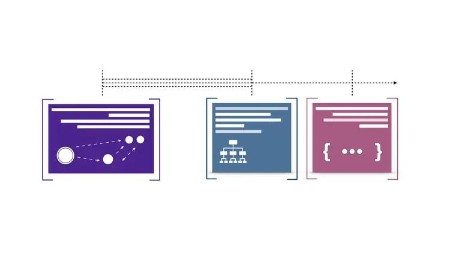
Building a Transpiler from scratch
Published 7/2023
Duration: 2h | .MP4 1280×720, 30 fps(r) | AAC, 44100 Hz, 2ch | 853 MB
Techniques of high-level compilation
What you’ll learn
Compile your programming language to JavaScript
High-level compilers pipeline
AST (Abstract Syntax Tree) transformation
Code generation
Syntactic sugar
Runtime modules
Cooperative multitasking
Lightweight processes (aka "Green threads")
Message-passing mechanism
Concurrent execution of processes
Parsing tools
Requirements
Basic JavaScript knowledge, JS generators
Interest in building programming languages
Basic data structures (lists, trees, traversal)
Description
Course overview
In recent compilers implementation, it became popular to translate from one high-level language to
another high-level language
. Examples might be desugaring new version of JavaScript to an older version of JavaScript, or languages like TypeScript, etc. Such high-level compilers are known today as
transpilers
, and what is the topic of our course.
It proved to be very practical, since we can fully rely on an existing runtime such as a JavaScript engine, avoid dealing with lower-level constructs like memory, bytecode instructions, etc.
hands-on practical approach
, and which we apply in this class.
Often related books on compilers go to theoretical aspects, stucking in parsing, regular grammars, etc – not explaining how actually to build a practical transpiler. I believe we should be able to build a transpiler for a
full programming language,
end-to-end
, in 2-4 hours
– with a content going straight to the point, showed in live coding sessions as pair-programming and described in a comprehensible way.
In the
Building a Transpiler from scratch
class we focus on compiling a high-level
concurrent programming language
with
message-passing processes
, down to JavaScript. That is, in addition to the deep dive on the transpiling, you will get a better understanding of how concurrent functional languages, such as
Erlang
, or even an operating system itself with its processes and threads, work today.
Implementing a transpiler will also increase your engineering level, as it touches several aspects of data structures and algorithms.
Prerequisites
An
optional
prerequisite for this class is the
Building an Interpreter from scratch
(aka
Essentials of Interpretation
) course, where we build an AST-interpreter for a full programming language. Unless you already have understanding of how programming languages work at this level, i.e. what eval, a
closure
, a
scope chain
,
environments
, and other constructs are – it is recommended to take the interpreters class as a prerequisite.
Who this class is for?
This class is for any
curious engineer
, who would like to gain skills of building complex systems (and building a transpiler for a programming language is an advanced engineering task!), and obtain a transferable knowledge for building such systems.
If you are interested specifically in compilers, PL and Type theory, and want to build a transpiler for your programming language, this class is also for you.
What is used for implementation?
We build the transpiler in JavaScript, compiling to JavaScript.
JavaScript
, being the most popular programming language, should be accessible for many engineers, and also our goal is to provide a
simple and concise
implementation, not focusing on specifics of a host language. So the code should be portable to any language of your taste and choice: TypeScript, Rust, OCaml, C++, Python, etc.
Note:
we want our students to actually follow, understand and implement every detail of the Transpiler themselves, instead of just copy-pasting from final solution. Even though the full source code for the transpiler is presented in the video lectures, the code repository for the project contains
/* Implement here */
assignments, which students have to solve.
What’s specific in this class?
The main features of these lectures are:
Concise and straight to the point.
Each lecture is self-sufficient, concise, and describes information directly related to the topic, not distracting on unrelated materials or talks.
Animated presentation
combined with
live-editing notes
. This makes understanding of the topics easier, and shows how the object structures are connected. Static slides simply don’t work for a complex content.
Live coding session
What is in the course?
The course is divided into
, in total of
18 lectures
, and many
sub-topics
in each lecture. Below is the
table of contents and curriculum
.
Who this course is for:
Curious software engineers who want to build their own programming language compiling to JavaScript
Compiler engineers

RapidGator
https://www.keeplinks.org/p27/68fddf3b71855
https://rapidgator.net/file/b97c277b70c2a8d6536c7db7c9ffbb59/yxusj.Dmitry.Soshnikov.-.Building.a.Transpiler.from.scratch.rar
NitroFlare
https://www.keeplinks.org/p27/68fddfc1d9c70
https://nitroflare.com/view/582487C0C9A0E19/yxusj.Dmitry.Soshnikov.-.Building.a.Transpiler.from.scratch.rar
DDownload
https://www.keeplinks.org/p27/68fde0188e7fa
https://ddownload.com/srd6wtr5fj5t/yxusj.Dmitry.Soshnikov.-.Building.a.Transpiler.from.scratch.rar