

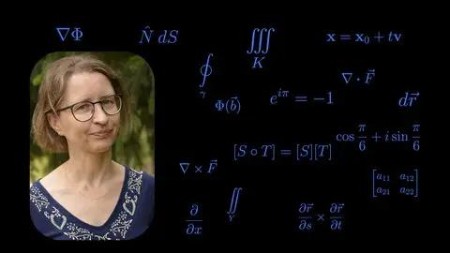
MP4 | Video: h264, 1280×720 | Audio: AAC, 44100 Hz
What you’ll learn
7 types of integrals: double, double improper, triple, line and surface integrals of functions and of vector fields.
Green’s, Stokes’ and Gauss’ theorems.
Conservative vector fields and their potentials; fundamental theorem for conservative vector fields.
Gradient, curl and divergence.
Five methods of computing line integrals of vector fields and four methods of computing surface integrals of vector fields (flux integrals).
Requirements
Calculus 1 and 2
Some linear algebra
Description
Towards and through the vector fields
(Chapter numbers in Robert A. Adams, Christopher Essex: Calculus, a complete course. 8th or 9th edition.)
C4 Multiple integrals (Chapter 14)
Introduction to the course; repetition (Riemann integrals, sets in the plane, curves)
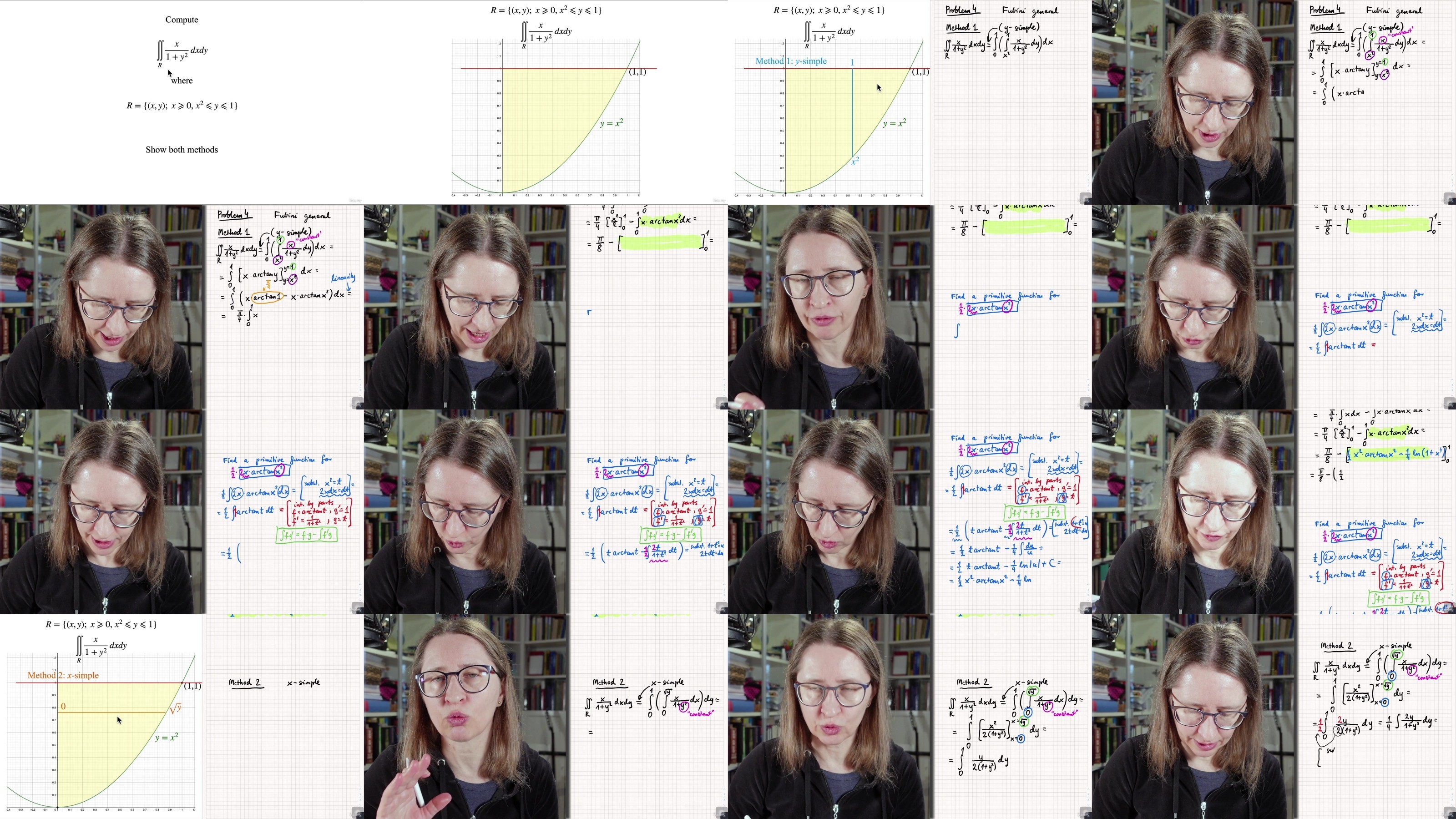
Double integrals on APR (axis-parallel rectangles), x-simple and y-simple domains; iteration of double integrals (Fubini’s theorem)
You will learn: compute double integrals by iteration of single integrals.
Improper integrals.
Applications of multiple integrals such as mass, surface area, mass centre.
C5 Vector fields (Chapter15)
Vector fields, conservative vector fields.
You will learn: about vector fields in the plane and in the space; conservative vector fields; use the necessary condition for a vector field to be conservative; compute potential functions for conservative vector fields.
Line integrals of functions and line integral of vector fields.
You will learn: calculate both kinds of line integrals and use them for computations of mass, arc length, work; three methods for computation of line integrals of vector fields.
Surfaces and surface integrals.
Oriented surfaces and flux integrals.
You will learn: determine orientation of a surface; determine normal vector field; choose orientation of a surface which agrees with orientation of the surface’s boundary; calculate flux integrals and use them for computation of the flux of a vector field across a surface.
C6 Vector calculus (Chapter16: 16.1-16.5)
Gradient, divergence and curl and some identities involving them; irrotational and solenoidal vector fields (Ch. 16.1-2)
Green’s theorem in the plane (Ch. 16.3)
Gauss’ theorem (Divergence Theorem) in 3-space (Ch. 16.4)
Stokes’ theorem (Ch. 16.5).
You will learn: define and compute curl and divergence of (two- and three-dimensional) vector fields and proof some basic formulas involving gradient, divergence and curl; apply Green’s, Gauss’s and Stokes’s theorems, estimate when it is possible (and convenient) to apply these theorems.
Who this course is for:
University and college engineering
TurboBit
https://filecrypt.cc/Container/FFF061003F.html
https://www.keeplinks.org/p27/67a476b98352b
RapidGator
https://filecrypt.cc/Container/D85E1E3B56.html
https://www.keeplinks.org/p27/67a47a482f940
AlfaFile
https://filecrypt.cc/Container/45090DB97D.html
https://www.keeplinks.org/p27/67a47add8d769