Cie International A-Level Maths: Pure Mathematics 2/3
Published 7/2023
MP4 | Video: h264, 1280×720 | Audio: AAC, 44.1 KHz
Master the content from Papers 2 & 3 (Pure Mathematics 2 & 3) of Cambridge International A-Level Maths
What you’ll learn
Calculus
Trigonometry
Differential Equations
Complex Numbers
Vectors
Algebra
Requirements
A good understanding of the content covered in my CIE International: A-Level Maths: Pure Mathematics 1 course, or equivalent AS maths knowledge.
Description
Overview
Section 1: Introduction
Lecture 1 Introduction
Lecture 2 What’s the Difference Between Paper 2 and Paper 3?
Section 2: Algebra
Lecture 7 Polynomial Division
Lecture 8 Polynomial Division – Examples – 1
Lecture 9 Polynomial Division – Examples – 2
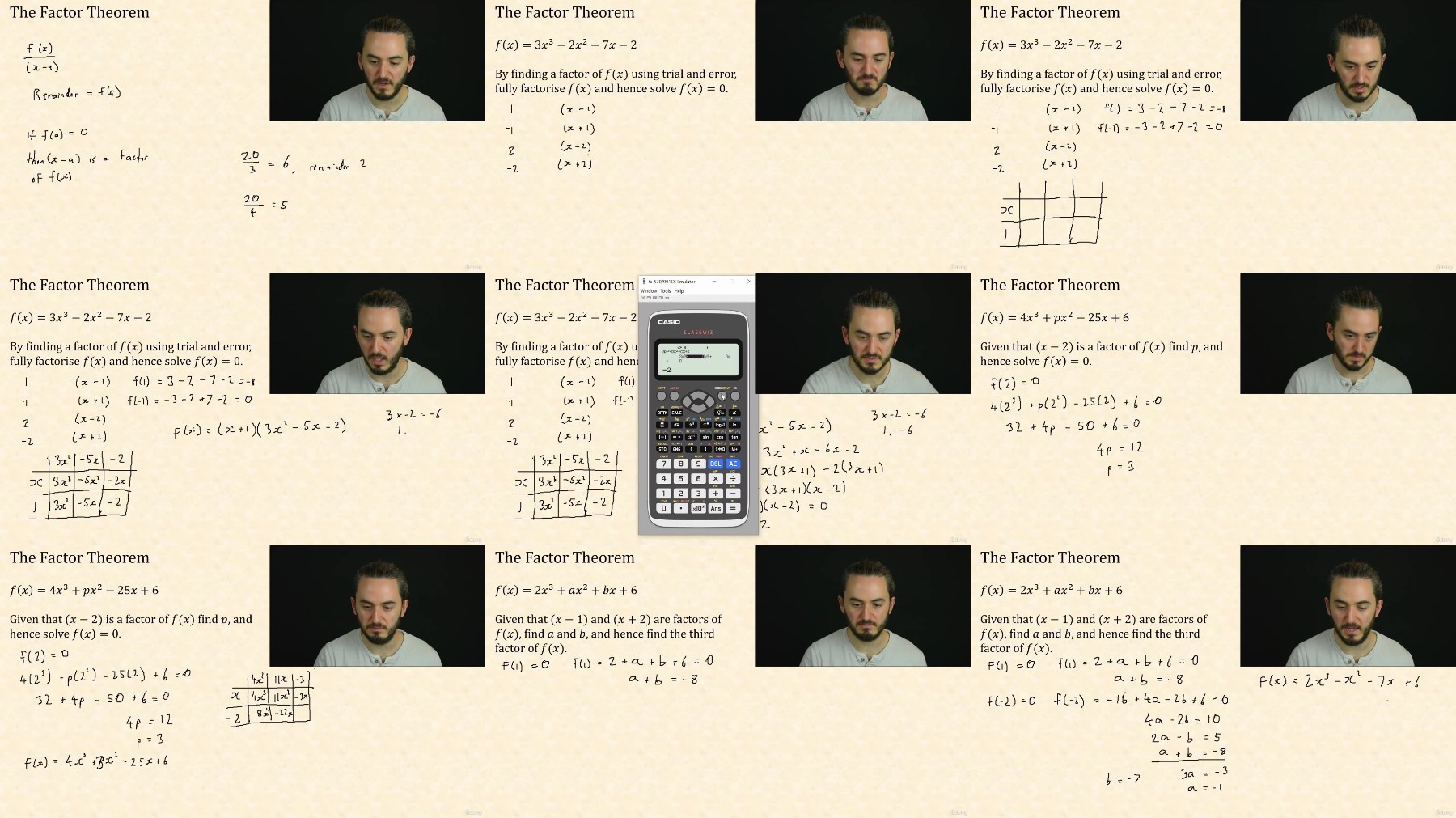
Lecture 12 The Factor Theorem
Lecture 13 The Long Division Method
Section 3: Logarithms and Exponential Functions
Lecture 14 Exponential Functions – Intro
Lecture 15 THE Exponential Function
Lecture 16 Differentiating e^x
Lecture 17 Exponential Modelling
Lecture 18 Logarithms – Intro
Lecture 19 Simplifying Logarithms
Lecture 20 Logarithms Laws
Lecture 21 Using Log Laws
Lecture 24 The Natural Logarithm
Lecture 25 Logarithmic Graph
Lecture 26 Non-Linear Data – Exponential Models
Lecture 27 Non-Linear Data – Polynomial Models
Lecture 28 Non-Linear Data – Exam Questions
Section 4: Trigonometry
Lecture 29 Sec, Cosec and Cot
Lecture 30 Graphs of Sec, Cosec and Cot
Lecture 31 Sec, Cosec and Cot – Simple Identities
Lecture 32 Sec, Cosec and Cot – Simple Equations
Lecture 33 The Pythagorean Identities
Lecture 34 The Pythagorean Identities – Proving Identities
Lecture 35 The Pythagorean Identities – Solving Equations
Lecture 36 The Pythagorean Identities – Exam-Style Problems
Lecture 37 Inverse Trig Functions – Graphs
Lecture 38 Inverse Trig Functions – Calculations
Lecture 39 The Addition Formulae
Lecture 40 Using The Addition Formulae
Lecture 41 The Double Angle Formulae
Lecture 44 The Double Angle Formulae – Proving Identities
Lecture 45 The Double Angle Formulae – Exam-Style Problems
Lecture 46 Harmonic Form: acos(x) + bsin(x)
Lecture 47 Harmonic Form – Solving Equations
Lecture 50 Modelling With Trigonometric Equations
Section 5: Differentiation
Lecture 51 Differentiating Sin(x) and Cos(x)
Lecture 52 Using the Derivatives of Sin(x) and Cos(x)
Lecture 53 Differentiating Exponential Functions
Lecture 54 Differentiating Ln(x)
Lecture 55 The Chain Rule – f(x)^n
Lecture 56 The Chain Rule – Trigonometric Functions
Lecture 57 The Chain Rule – Exponential Functions
Lecture 58 The Chain Rule – Logarithmic Functions
Lecture 59 The Product Rule
Lecture 60 The Quotient Rule
Lecture 61 Derivatives of Tan, Sec, Cosec and Cot
Lecture 62 Using the Derivatives of Tan, Sec, Cosec and Cot
Lecture 63 Implicit Differentiation
Lecture 64 Implicit Differentiation – Stationary and Critical Points
Lecture 65 Second Derivatives – Convex and Concave Functions
Lecture 66 Parametric Equations – Introduction
Lecture 70 Intersections of Parametric Equations and Lines
Lecture 71 Differentiating Parametric Curves
Lecture 72 Differentiating Parametric Curves – Stationary Points
Section 6: Integration
Lecture 73 Integrating Standard Functions
Lecture 74 Integrating f(ax + b)
Lecture 75 Trigonometric Identities For Integration – Pythagorean Identities
Lecture 76 Trigonometric Identities For Integration – Double Angle Formulae
Section 7: Numerical Solutions of Equations
Lecture 77 Locating Roots
Section 8: Further Algebra
Lecture 84 The Binomial Expansion Formula (When n is Not a Positive Integer)
Lecture 85 Using the Binomial Expansion Formula
Lecture 86 Binomial Expansion When the First Term is Not 1
Lecture 87 Approximations
Lecture 88 Binomial Expansion – Algebraic Fractions
Section 9: Further Integration
Lecture 92 Reverse Chain Rule – Exponentials
Lecture 95 Mixed Reverse Chain Rule Problems
Lecture 102 Integration By Substitution 1: Alternative to Reverse Chain Rule
Lecture 103 Integration By Substitution 2: u = f(x)
Lecture 104 Integration By Substitution 3: x = f(u)
Lecture 105 Integration By Substitution – Definite Integrals
Lecture 106 Integrating Arctan-Like Functions
Lecture 107 Problem Solving With Integration
Lecture 108 The Trapezium Rule
Section 10: Vectors
Lecture 109 The Vector Equation of a Straight Line
Lecture 110 Parallel and Skew Vectors
Lecture 112 The Scalar (Dot) Product – Introduction
Lecture 113 Using the Scalar Product to Find Angles
Lecture 114 Using the Scalar Product to Find Shortest Distances and Closest Points
Section 11: Differential Equations
Lecture 117 Forming Differential Equations
Section 12: Complex Numbers
Lecture 120 Complex Numbers – Introduction
Lecture 121 Addition, Subtraction and Multiplication of Complex Numbers
Lecture 122 Division of Complex Numbers
Lecture 123 Square Roots of Complex Numbers
Lecture 124 Complex Roots of Quadratic Equations
Lecture 126 The Argand Diagram
Lecture 127 Modulus and Argument
Lecture 128 Modulus-Argument / Polar Form of a Complex Number
Lecture 129 Exponential Form of a Complex Number
Lecture 130 (Optional!) Explanation of Why the Exponential Form Works
Lecture 134 Euler’s Identity
Lecture 135 Complex Loci – Circles
Lecture 136 Complex Loci – Perpendicular Bisectors
Lecture 137 Complex Loci – Arguments
People studying the Cambridge International A-Level Mathematics AS or A-Level,People who want to study an intermediate-advanced course in pure mathematics