


Complete Course Of Fundamentals Of Fluid Mechanics – 2023
Last updated 4/2023
MP4 | Video: h264, 1280×720 | Audio: AAC, 44.1 KHz
Elevate Your Engineering Skills with Our Professionally Designed 15-Hours Course- A Perfect Blend of Theory and Practice
What you’ll learn
Understanding the application areas of fluid mechanics, including aerodynamics, hydrodynamics, and industrial fluid flow systems.
Learning the fundamental principles of dimensional analysis, including units and dimensions, dimensional homogeneity, and dimensional analysis.
Understanding the nature of fluids, including the no-slip condition, shear stress, and viscosity, as well as the different types of fluids.
Learning how to calculate shear stresses and velocity profiles, and understanding the behavior of shear thickening and shear thinning fluids.
Understanding the concept of pressure and hydrostatic pressure, and learning how to calculate specific gravity.
Learning how to use different types of manometers, such as the piezometer and U-tube manometer, to measure pressure and calculate buoyancy.
Understanding the concept of fluid flow rates, including continuity equation, commercial pipe and tubing, and pipe selection.
Learning how to apply the principles of Bernoulli’s equation to calculate volumetric flow rates in different applications,such as tanks, reservoirs and venturi.
Understanding the general energy equation and its applications to pumps, fluid motors, and valves and fittings.
Understanding the concept of Reynolds number and its applications to laminar and turbulent flow, as well as the hydraulic radius for non-circular pipes.
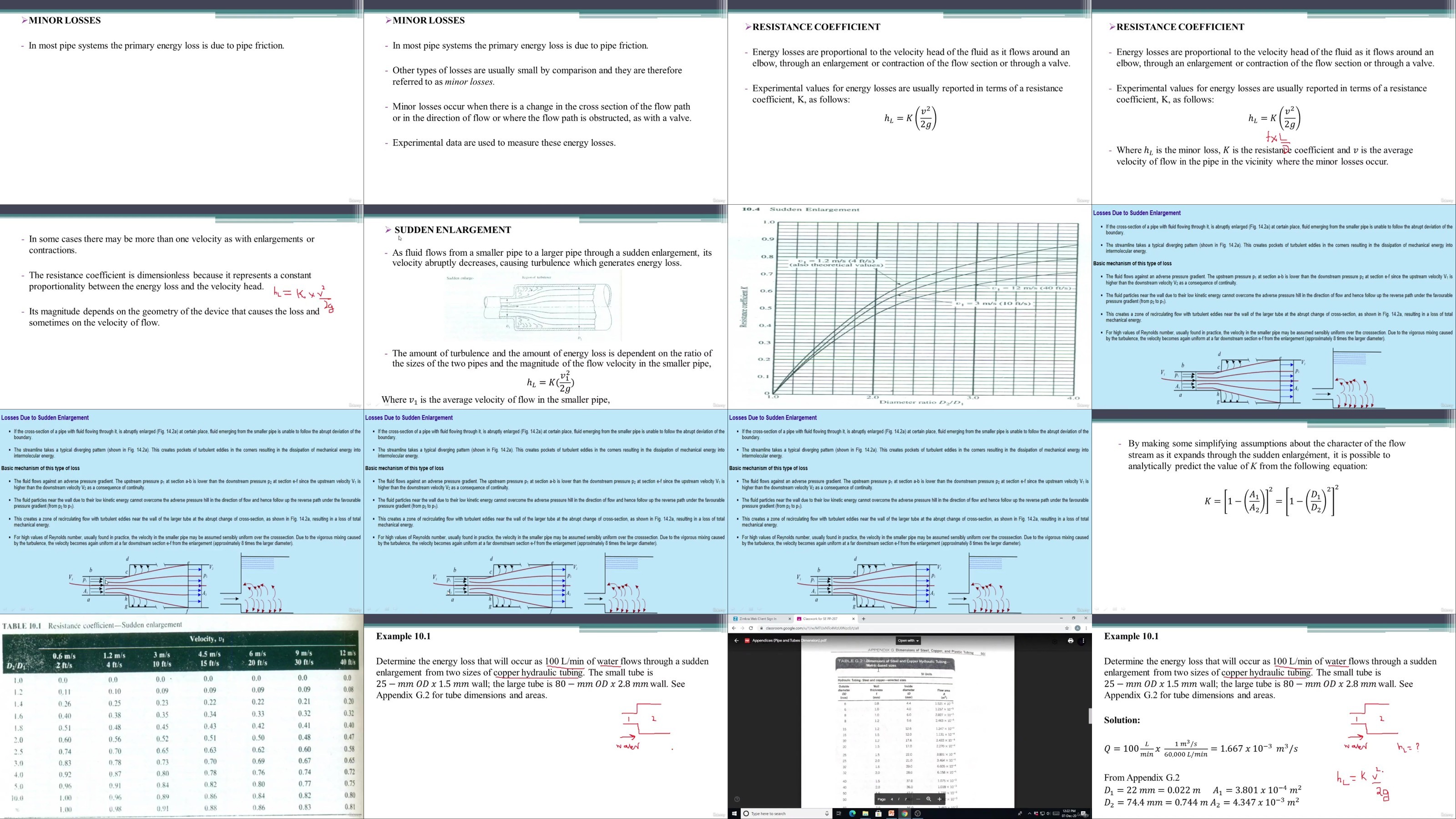
Understanding the concept of minor losses and their impact on fluid flow, as well as calculating energy losses due to enlargements and contractions.
Learning how to calculate all energy losses in moving fluid, including losses through valves and fittings, and understanding the resistant coefficient.
Learning how to measure flow rate and velocity in open channel flow, including weirs, rectangle notches, contracted weirs, and triangle weirs.
Understanding the different types of positive displacement pumps, including reciprocating, rotary, kinetic, self-priming, and centrifugal pumps.
Learning about cavitation and vapor pressure, and understanding the importance of NPSH margin and impeller size in pump performance.
Requirements
A basic understanding of mathematics and physics, including calculus, algebra, and Newtonian mechanics.
Familiarity with basic concepts of engineering, such as units and dimensions, as well as some exposure to fluid mechanics and fluid dynamics, either through prior coursework or self-study.
Description
Overview
Section 1: Introduction to Fluid Mechanics
Lecture 1 Introduction to Fluid Mechanics, Applications,Importance of Dimensions and Units
Lecture 2 Dimensions, Dimensional Homogeneity and Unity, Example Problem
Lecture 3 Problem Related to Dimensional Analysis, Dimensionless Numbers
Lecture 4 Measure of Fluid Density, Specific WeightSpecific Gravity and relation b/w them
Lecture 5 Problems Related to Fluid Analysis, Classification of Fluids
Lecture 6 Problems Related to Reynold, Bingham & Nusselt numbers
Section 2: Nature of Fluids and Viscosity
Lecture 7 Nature of Fluids (The no Slip Condition in Fluid Dynamics)
Lecture 8 Shear Stress in Moving Fluid (shear stress is proportional to strain rate)
Lecture 9 Viscosity, Fluid Types, Shear Thickening Fluids and Shear Thinning Fluid
Lecture 10 Problems Related to Newton Law of Viscosity and calculation of Shear Stresses
Lecture 11 Reynolds Number, Calculation of Reynolds Number, Velocity Profiles
Section 3: Pressure and Buoyancy
Lecture 12 Fluid Pressure and Hydrostatic Pressure, Calculation of Specific Gravity
Lecture 13 Manometry (Piezometer, U tube manometer, Differential Monometer)
Lecture 14 Buoyancy, Steps for solving Buoyancy Problems, Question related to Buoyancy
Lecture 15 Problems related to Buoyancy
Section 4: Fluid Flow Rates and Bernoulli’s Equation
Lecture 16 Fluid Flow Rates, Flow Rates, Continuity Equation, Question Related to Flow Rate
Lecture 17 All type of Commercially Available Pipe and Tubing, Pipe Selection Aid
Lecture 18 Problems to Calculate Volume Flow Rate and Pipe and Tube Size from tables.
Lecture 19 Bernoulli’s Equation, Interpretation and Restriction on Bernoulli’s Equation
Lecture 20 Problems Related to Bernoulli’s Equation
Lecture 21 Calculation of volumetric flow rate through the nozzle using Bernoulli
Lecture 22 Application of Bernoulli’s Equation (Tanks, Reservoirs and Nozzles )
Lecture 23 Calculation of volumetric flow rate in Venturi Meter, Torricelli’s Theorem
Lecture 24 Problems related to Torricelli’s Theorem
Lecture 25 Complex Problem related to Bernoulli’s Equation
Section 5: General Energy Equation and Pump Efficiency
Lecture 26 General Energy Equation,Mechanical Energy and Efficiency, Nomenclature of Energy
Lecture 27 Problems Related to Energy Equation(Pumps, Fluid Motors, Fluid Friction, Valves)
Lecture 28 Power Required and Mechanical Efficiency of Pumps, Numerical related to pumps
Lecture 29 Problem related to Mechanical Efficiency of the Pump
Lecture 30 Power Delivered and Mechanical Efficiency of Fluid Systems with solve Numerical
Section 6: Reynolds Number and Friction Loss
Lecture 31 Reynolds Number and Hydraulic Radius for closed non circular cross sections
Lecture 33 Problem related to the calculation of Reynolds Number for non-circular pipes
Lecture 34 Friction Loss in non-circular cross section, Numerical Related to Friction loss
Lecture 35 Energy Loss by Friction,Darcy’s Equation, Friction Loss in Laminar and Turbulent
Section 7: Energy Losses
Lecture 36 Minor losses, Looses Due to Sudden Enlargements and Numerical
Lecture 37 Calculate energy loss due to Sudden enlargements
Lecture 38 Exit Loss and Gradual Enlargement and Numericals related to these topics
Lecture 39 Sudden Contraction, Calculation of energy loss due to sudden contraction
Lecture 40 Gradual Contraction, Entrance Loss, Calculation of energy loss due to Entrance
Lecture 41 Minor Losses and Resistant Coefficient through Valves and Fittings
Lecture 42 Numericals for the Calculation of all the Energy Looses
Lecture 43 Continue to Previous Problems
Section 8: Flow Measurement
Lecture 44 Flow Measurement through (Venturi, Flow Nozzle, Orifice), Selection Factors
Lecture 46 Flow Measurement through Weirs, Rectangle Notch, Contracted Weir, Triangle Weir
Section 9: Pumps and Cavitation
Lecture 47 Positive Displacement Pumps, Reciprocating Pumps, Rotary Pump
Lecture 48 Kinetic Pump,SelfPriming Pump,Centrifugal Pump,Affinity Law for Centrifugal pump
Lecture 49 Numerical using Affinity Law, Manufacture’s data for centrifugal pumps
Lecture 50 Effect of Impeller Size, power Efficiency, Cavitation,Vapor Pressure NPSH Margin
DDownload
https://www.keeplinks.org/p27/687c172b3bfbb
RapidGator
https://www.keeplinks.org/p27/687c17e5b45c6
NitroFlare
https://www.keeplinks.org/p27/687c19d8dd93f