

Eeg/Erp Analysis With Python And Mne: An Introductory Course
Published 2/2024
MP4 | Video: h264, 1280×720 | Audio: AAC, 44.1 KHz
From Brain Signal Basics to Advanced Analysis
What you’ll learn
Understanding the Basics of Electrophysiology Data
Gain Expertise in Frequency Domain Analysis of Electrophysiological Data
Learn to Identify and Analyze ERPs
Acquire the Practical Skills to Conduct Time-Frequency Analysis using Python and the MNE library.
Requirements
No Programming Skill Required. The only software requirement is Anaconda, which is a popular Python distribution that simplifies package management and environment setup. You do not to have it installed in advance, since I will teach how to install and use it during the course. So the only thing you need is a computer and a keyboard!
Description
Overview
Section 1: Introduction to EEG
Lecture 1 A short history
Lecture 2 The Origins of EEG data
Lecture 3 How to record EEG
Lecture 4 What is a Good EEG
Section 2: Frequency and time domain analyses
Lecture 5 Different types of brain frequencies
Lecture 6 Frequency analysis
Lecture 7 Time-domain analysis and ERP
Lecture 8 Time-frequency analysis
Lecture 9 Different types of noises
Lecture 10 A symphony of noises in action
Lecture 11 Filters
Lecture 12 ANACONDA installation
Lecture 14 Basics of coding-Dictionary
Lecture 15 Working with functions
Lecture 16 Control statements
Lecture 17 Plotting
Lecture 18 MNE Installation
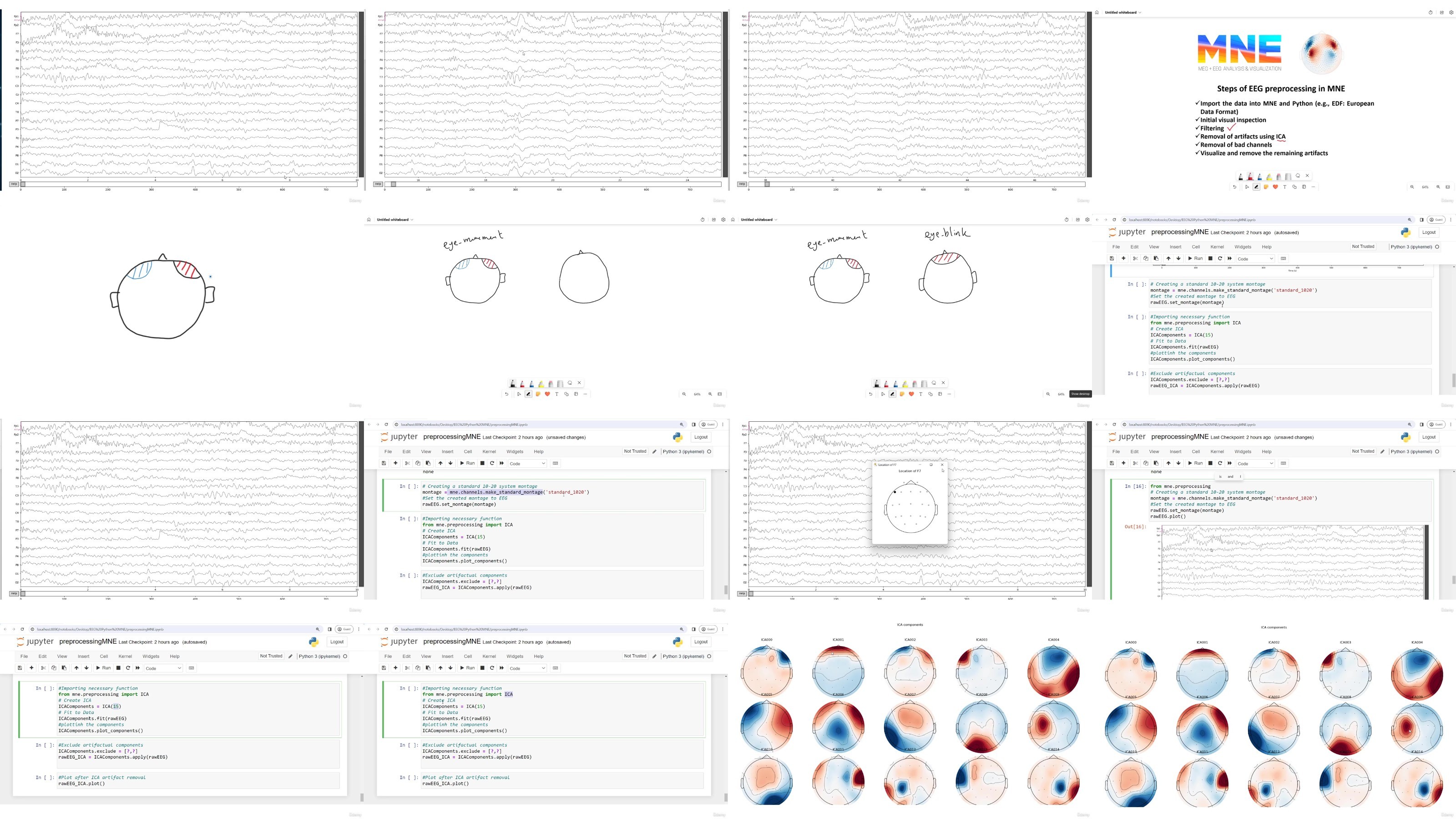
Section 5: Pre-processing with MNE-Python
Lecture 19 Importing and reviewing EEG data with MNE
Lecture 20 Filtering the data with MNE
Lecture 21 Saving steps into files
Section 6: Frequency analysis in Python and MNE
Lecture 24 Importing EEG in Python
Lecture 25 Frequency analysis in Python with FFT
Lecture 26 Frequency analysis in MNE
Lecture 27 Building custom frequency topographic maps
Section 7: Review of important ERPs
Lecture 28 Time course of stimuli in the brain
Lecture 29 The P300 component
Lecture 30 The N170 component
Lecture 31 The language-related components
Lecture 32 Age and development ERP issues
Section 8: ERP and time-frequency analysis in Python and MNE
Lecture 33 Trial-based EEG data
Lecture 34 Visualize single trials in Python
Lecture 35 Compute mean ERPs in Python
Lecture 36 Structure of EEG data with seperate condition
Lecture 37 Attaching labels to continues EEG data in MNE
Lecture 38 Epoching the events for MNE
Lecture 39 Compute and visualize ERPs in MNE
Lecture 40 Compute and visualze time-frequency in MNE
Lecture 41 Final words
Section 9: Extra+Advance with ChatGPT
Lecture 42 Extra Advance with ChatGPT
Lecture 43 Example
Lecture 44 ChatGPT Prompts
Section 10: Course Materials
Lecture 45 Course Materials
DDownload
https://www.keeplinks.org/p27/687231cce555d
RapidGator
https://www.keeplinks.org/p27/6872323e3182f
NitroFlare
https://www.keeplinks.org/p27/6872339527569