

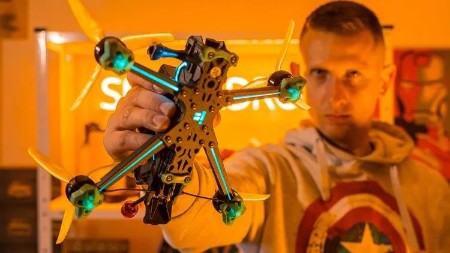
FPV – Course from Beginner to Pro. Complete Theory
Instructor: Yurii Bobyr
fpv, theory, building, drone, drones, freestyle, tinywhoop, cinelifter, cinewhoop
What you’ll learn
- Complete theory that every FPV pilot must know
- FPV drone engineering and detailed component overview
- Programming an FPV drone in Betaflight
- Selection and setup of main FPV drone components
Requirements
To learn, you need to have a good attitude and a desire
Description
Course Content:
Lesson 1: Classification of FPV Drones
Lesson 2: FPV Drone Construction
General overview of components and their interaction. Frame, Motors, Electronic Speed Controller (ESC), Capacitor, Flight Controller (FC), Integrated AIO boards, Separate ESC and PDB boards, Receiver (RX), Video Transmitter (VTX), Camera, Antenna, GPS module, Buzzer.
Lesson 3: FPV Drone Frames
Choosing a frame. Detailed review of frame construction. Importance of quality and arm thickness. Impact of frame size on flight style. Racing FPV drone. Drone for videography. Drone for long-distance flights. Material selection. Size of the central mounting scheme. Calculation of frame and propeller size. Frame shapes (True-X, Stretch X, Deadcat, H-frames, Box frames, Plus frames). Frame materials. Mounting holes on the arms. Aesthetics and additional aspects of frame selection.
Lesson 4: Flight Controller (FC)
Lesson 5: Speed Controller (ESC)
Main function of ESC. Changing motor rotation direction. Active braking. ESC protective functions. Power consumption optimization. Control protocols (PWM, PPM, Oneshot, Multishot, DShot). Importance of hardware compatibility. Proper ESC mounting on the frame. Motor rotation setting schemes (Props In and Props Out). Types of ESC. 4-in-1 ESC. Separate ESC. Selecting ESC based on parameters. ESC firmware (BLHeli_S, Bluejay, BLHeli_32, AM32).
Lesson 6: Motors
Key characteristics for motor selection. Types of motors. Motor construction. Propeller size selection. Current consumption calculation. KV rating. Thrust calculation. Number of poles and magnets. Mounting dimensions. Types of motors for FPV drones. Impact of stator size on torque. Popular motor sizes. Impact of drone weight on motor selection. Battery impact on motor speed. Motor selection based on thrust parameters. ESC selection for motors. Motor maintenance.
Lesson 7: Propellers
Propeller selection depending on the task. Determining propeller size for the frame. Propeller pitch selection. Review of propeller materials. Compatibility with motors. Propeller shapes (Normal, Bullnose, Hybrid Bullnose, RaceKraft, Bi-blade, Tri-blade, for 3D flights). Propeller mounting. Impact of the number of blades on stability and thrust. Balance of efficiency and power. Blade number selection for different tasks. Importance of propeller weight for performance. Blade weight distribution.
Lesson 8: Video Transmitter, Goggles, Camera
Lesson 9: Receiver, Radio Transmitter, and External Modules
Operating frequencies for receivers and radio transmitters. Control protocols. Pros and cons of ExpressLRS. Update rates. Pros and cons of Crossfire. Compatible frequencies and antennas for ELRS. Radio transmitters. Importance of initial purchase. Radio transmitter firmware. EdgeTX or OpenTX. Switch types on the transmitter. Stick settings. Transmitter modes. Internal transmitter protocols. ELRS, CC2500, 4 in 1. LBT or FCC. External modules. Module installation. Operating frequencies and update rate. Receiver soldering to FC. Binding process. Receiver mounting to the frame. PA, LNA, TCXO. Diversity system receivers and their mounting.
Lesson 10: Antennas, Radio Frequencies, Reading Radiation Patterns, VSWR, Impedance
Antenna structure. Antenna working principle. Antenna directionality. Reading radiation patterns. Antenna polarization. Types of antennas. Antenna selection for video receiver and transmitter. Drone control antenna selection. Antenna gain. Radiation pattern formation. Axial ratio. VSWR value and measurement. Impedance impact on antenna performance.
Lesson 11: Batteries. Charging Stations. Safety.
Battery components. LiPo battery manufacturing process. Differences between LiPo and Li-ion batteries. Optimal battery capacity selection. Voltage impact on drone performance. Choosing between 4S and 6S batteries. Important aspects during flight. Voltage balance of cells. C Rating. Parallel and series connection. Internal resistance measurement. Types of batteries. Battery charging. Practical tips for battery usage. Battery disposal. Actions in case of battery fire.
Lesson 12: FPV Drone Telemetry and OSD.
Telemetry in Betaflight and the OSD function. Telemetry groups. Telemetry selection for specific tasks and needs. Importance of using RSSI dBm value and Link quality with examples.
Lesson 13: Drone Programming in Betaflight. Detailed Program Overview.
Who this course is for:
This course is suitable for both beginners and experienced pilots

DDownload
https://www.keeplinks.org/p27/68364d73413e9
RapidGator
https://www.keeplinks.org/p27/68364f023d696
NitroFlare