

Published 9/2024
MP4 | Video: h264, 1920×1080 | Audio: AAC, 44.1 KHz
Practical course to teach Assembly instruction, Register and Exception level in Armv7-A and Armv8-A
What you’ll learn
Understand the basic working principles of Arm architecture (Armv8-A, Armv7-A)
Understand the registers in Arm architecture (Armv8-A, Armv7-A)
Learn the processor modes defined in Armv7-A
Understand the exception levels defined in Armv8-A
Use the hardware debugger program, TRACE32, effectively
Requirements
Computer Architecture
Microprocessor
Description
Overview
Section 1: Introduction
Section 2: Introducing Registers
Lecture 3 What is the register?
Lecture 4 How to learn about register?
Lecture 5 Armv7-A: Register Overview
Lecture 8 Armv7-A: banked register: R14_
Lecture 9 CPSR (The Current Program Status Register)
Lecture 10 SPSRs (The Special Program Status Register)
Lecture 11 How SPSRs are updated (Interrupt)
Section 5: Armv8-A – Register
Lecture 12 Introducing register in Armv8-A
Lecture 13 General-purpose registers
Lecture 14 Special Registers
Lecture 15 ELR_ELx – Exception link register
Lecture 16 Introducing SPSR_ELx register
Lecture 17 How is SPSR_ELx register updated during generation of exception
Section 6: Mastering Register with TRACE32 debugging
Lecture 18 Armv7-A: Identify the general-purpose register
Section 7: Armv8-A: System registers
Lecture 21 Introducing System registers in Armv8-A
Lecture 22 Example of system register – HCR_EL2
Lecture 23 The lowest exception level for system registers
Lecture 24 Write or Read the system registers: MSR and MRS
Section 8: Introducing Assembly instruction
Lecture 25 What is it challenging to learn about assembly instruction?
Lecture 26 What can we do using assembly instruction: 1. Bringup
Lecture 27 What can we do using assembly instruction: 2. Develop device driver
Lecture 28 What can we do using assembly instruction: 3. Improve debugging ability
Lecture 29 Basic form of assembly instruction
Lecture 30 MOVE instruction
Section 9: Arithmetic instruction
Lecture 31 ADD instruction
Lecture 32 ADD instruction (TRACE32 practice)
Lecture 33 SUB instruction
Lecture 34 SUB instruction (TRACE32 practice)
Section 10: Logical operation
Lecture 35 AND instruction
Lecture 36 AND instruction (TRACE32 debugging)
Lecture 37 ORR instruction
Lecture 38 ORR instruction (TRACE32 debugging)
Lecture 39 ORN instruction
Lecture 40 BIC instruction
Lecture 41 EOR instruction
Section 11: Bit shift operation
Lecture 42 Introducing Bit Shift operation
Lecture 43 LSL instruction
Lecture 44 LSR instruction
Section 12: Branch operation
Lecture 45 B instruction
Lecture 46 BL instruction
Lecture 47 BX instruction – Armv7
Lecture 48 BLX instruction – Armv7
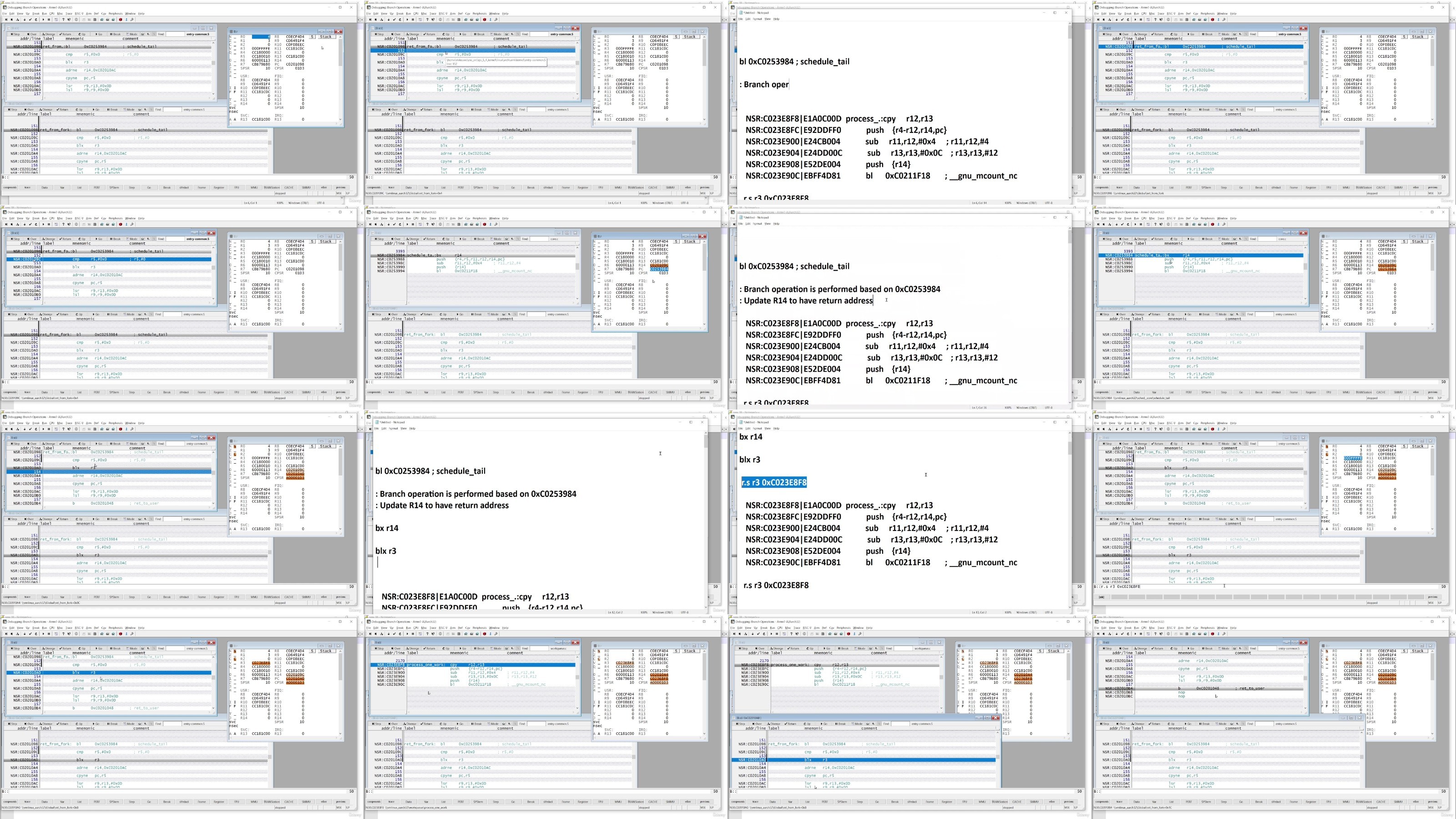
Lecture 49 BX, BLX instruction (TRACE32 Debugging Practice)
Lecture 50 BR instruction – Armv8
Lecture 51 BLR instruction – Armv8
Section 13: Conditional branch operation
Lecture 54 Introduction to conditional operation
Lecture 55 CBZ instruction
Lecture 56 CBNZ instruction
Lecture 57 TBZ instruction
Lecture 58 TBZ instruction (TRACE32 debugging)
Lecture 59 TBNZ instruction
Lecture 60 TBNZ instruction (TRACE32 debugging)
Section 14: Exception-generating instruction
Lecture 61 SVC instruction
Lecture 62 HVC instruction
Lecture 63 SMC instruction
Section 15: Memory Access operation
Section 16: Processor mode(Armv7-A)
Lecture 68 User mode
Lecture 69 Supervisor mode
Lecture 70 IRQ mode and FIQ mode
Lecture 71 Abort mode
Lecture 72 Undefined mode
Lecture 73 Introduction to Exception level in Armv8 architecture
Lecture 74 Exception level-Arm specification review
Lecture 75 Why BSP software engineer should learn Exception Levels?
Lecture 76 Details of EL0(User application) in Linux system
Lecture 77 Example code at EL0 in Linux system
Lecture 78 EL0 in Virtualization and TrustZone feature
Lecture 79 Exception level change at EL0 in virtualization (Big picture)
Lecture 80 Details of EL1(Linux kernel) in Linux system
Lecture 81 Highlight: Exception handling at EL1
Lecture 82 Memory abort Exception handling at EL1
Lecture 83 Memory system in case of Memory abort
Lecture 84 IRQ(Interrupt) Exception handling at EL1
Lecture 85 IRQ(Interrupt) handling – Software point of view
Lecture 86 Read CurrentEL system register to identify exception level
Lecture 87 Enter EL1 from EL0 via SVC instruction
Lecture 88 Enter EL2 from EL1 via HVC instruction
System software engineer (Linux BSP engineer),Chipset BSP and firmware software engineer,Automotive system software engineer,System software engineers who are eager to level up debugging skills,Professionals interested in exploring Armv8 and Armv7 architecture
https://filecrypt.cc/Container/E6639588F3.html
https://www.keeplinks.org/p27/677a42ef03c61
https://filecrypt.cc/Container/EC2161A466.html
https://www.keeplinks.org/p27/677a43c07f32e
https://filecrypt.cc/Container/60AEAFD9AF.html
https://www.keeplinks.org/p27/677a441c89a8a