


Hands-On Data Engineering & Data Analysis with Azure Cloud
MP4 | Video: h264, 1920×1080 | Audio: AAC, 44.1 KHz, 2 Ch
Welcome to
Hands-On Data Engineering & Data Analysis with Azure Cloud
.
Data is at the center of modern businesses, but collecting data is only the beginning. Organizations need professionals who can
store, process, transform, analyze, and move data efficiently
.
This course is designed to help
beginner and intermediate learners
build practical skills in
Data Analysis, SQL, Python, Cloud Computing, and Azure Data Engineering
through hands-on learning.
Before working with tools, you will build a strong understanding of important concepts such as:
•
Data, Databases, and DBMS
•
Data Analysis
•
Data Engineering
•
Data Lifecycle
•
Modern Data Platforms
•
ETL vs ELT
•
Structured and Semi-Structured Data
•
Cloud Computing
These concepts will help you understand not only
how
to use data technologies, but also
why and where
they are used.
Learn SQL with Hands-On Practice
Next, you will learn SQL and relational database fundamentals.
You will work with SQL to:
•
Create databases and tables
•
Understand SQL data types
•
Insert single and multiple records
•
Retrieve data using SELECT
•
Rename result columns using aliases
•
Filter data using WHERE
•
Work with comparison operators
•
Combine conditions using AND, OR, and NOT
•
Filter using IN, LIKE, BETWEEN, and IS NULL
•
Sort data using ORDER BY
•
Use aggregate functions
•
Summarize data using GROUP BY
•
Filter aggregated results using HAVING
But this course goes beyond simply watching SQL demonstrations.
You will get
hands-on coding exercises
where you can write SQL yourself and test your understanding.
The course also includes
interactive role-play activities
designed to help you think like a Data Analyst and Data Engineer while solving realistic business requirements.
Python for Data Analysis
You will then explore
Python and Pandas for Data Analysis
.
You will learn how to:
•
Load and inspect datasets
•
Understand rows, columns, and dataset structure
•
Identify missing values
•
Handle NULL values
•
Use median and other calculations
•
Handle missing values while considering categories
•
Perform basic data calculations
•
Work with string functions
•
Clean and prepare data for analysis
This provides practical exposure to how Python can be used to explore and prepare real-world datasets.
Move to Microsoft Azure Cloud
Once the fundamentals are clear, we take our data engineering journey to the cloud.
You will learn how to work with important Azure data services including:
•
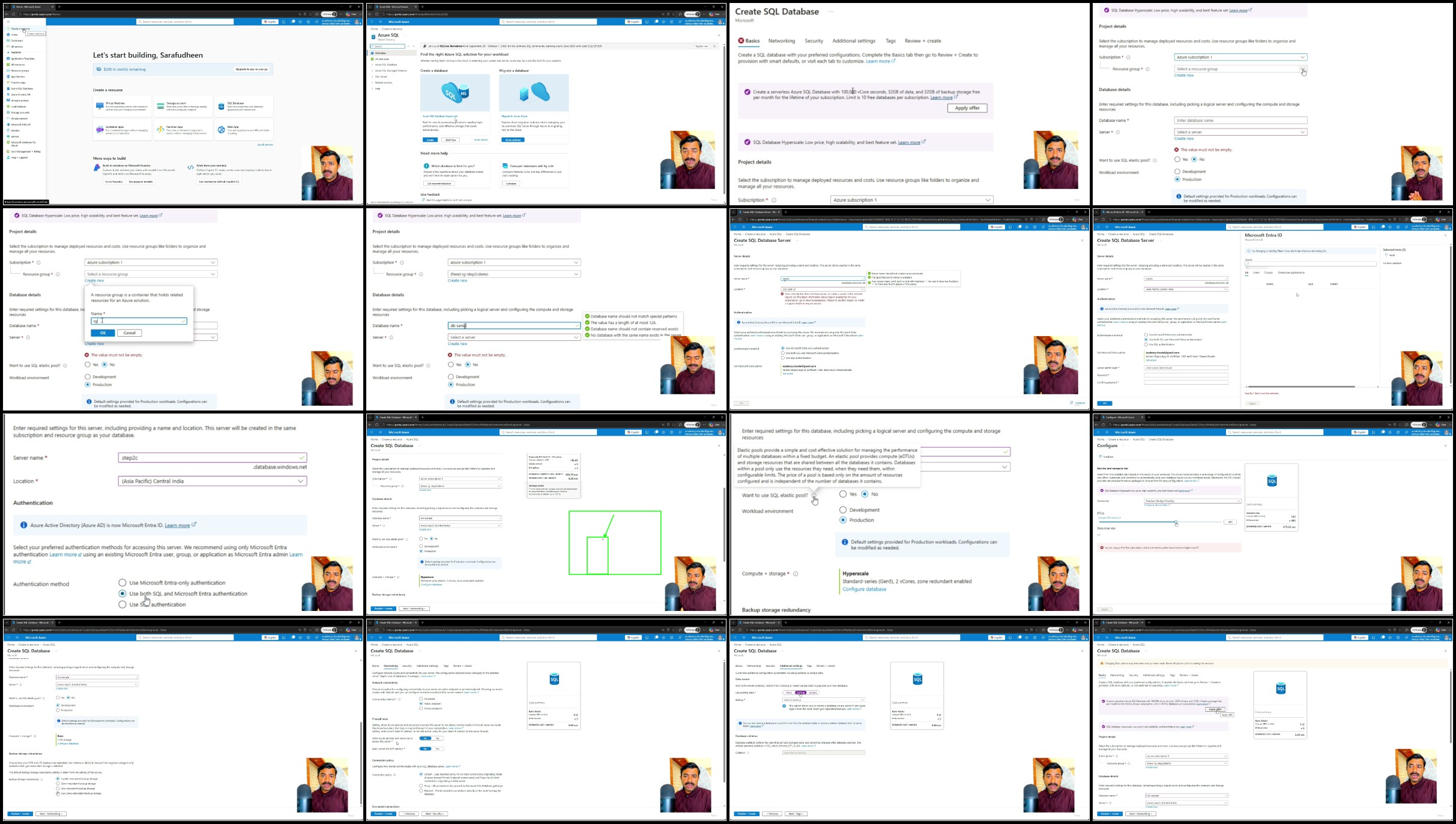
Azure SQL Database
•
Azure Data Lake Storage (ADLS)
•
Azure Data Factory (ADF)
You will create Azure resources and connect to Azure SQL using tools such as SQL Server Management Studio and Azure’s query tools.
Build Azure Data Factory Pipelines
Azure Data Factory
.
You will learn how to:
•
Create Azure Data Factory
•
Understand the ADF interface
•
Create Azure Data Lake Storage
•
Create Linked Services and Datasets
•
Connect source and destination systems
•
Build data pipelines
•
Copy data between systems
•
Execute and validate pipelines
•
Monitor pipeline executions
•
Create triggers to automate pipeline executions
•
Connect on-premises data using Self-hosted Integration Runtime
•
Move data from on-premises systems to Azure
•
Load multiple files
•
Build dynamic and reusable pipelines
Build Metadata-Driven Data Pipelines
Instead of creating a separate pipeline for every table or dataset, you will learn how to design a
metadata-driven architecture
.
You will see how metadata and dynamic configurations can help create more reusable and scalable data pipelines.
Implement Incremental Data Loading
Finally, you will work with one of the most important concepts in practical Data Engineering:
Incremental Loading
.
You will learn how to:
•
Understand full load vs incremental load
•
Work with watermark values
•
Identify new or modified records
•
Dynamically retrieve watermark values
•
Load only required incremental data
•
Update watermark values using stored procedures
•
Validate incremental loads using different sets of data
Instead of reloading an entire dataset every time, you will understand how to design pipelines that process
only new or changed data
.
Hands-On Learning Approach
The goal of this course is not just to introduce tools.
We follow a practical learning approach:
Understand the Concept → Practice It → Build with It
By the end of the course, you will have a much clearer understanding of how data moves from source systems through processing and storage to become useful information for analytics-and how modern Azure Data Engineering solutions can be built to support that journey.
If you’re ready to build practical skills in
Data Analysis and Azure Data Engineering
More Info
https://www.keeplinks.org/p27/6a9736ee0586e
https://rapidgator.net/file/04d3a662d507446029d6b573d24c75d7/
https://rapidgator.net/file/f4fc67991998de1b5059230360895557/
https://rapidgator.net/file/46216877fc5b256fff957d016b335bcc/
https://rapidgator.net/file/1f419b70e0a605effbbca2e08040ce7a/
https://rapidgator.net/file/6c8eb9b6b2ec3f81c614f21bd0492cb5/
DDownload
https://www.keeplinks.org/p27/6a9738ffbe1e0
https://ddownload.com/7f1vteotc8pj
https://ddownload.com/uycdoe78q8er
https://ddownload.com/bpwljevmgwuh
https://ddownload.com/v2rlxaqd9xup
https://ddownload.com/7jsboq111922
https://www.keeplinks.org/p27/6a973b7adf115
https://nitroflare.com/view/CB1A14FF8E4128A/
https://nitroflare.com/view/F4BB70C97DA83A3/
https://nitroflare.com/view/ADF826B6B14B29D/
https://nitroflare.com/view/86E3105CFA92269/
https://nitroflare.com/view/7FF5DB00087D71B/