


Innovative Pricing Models For It Services In The Digital Era
Published 1/2025
MP4 | Video: h264, 1920×1080 | Audio: AAC, 44.1 KHz
Gain practical expertise in IT services pricing with strategies, models and key factors impacting pricing in digital era
What you’ll learn
1. Acquire ‘practical pricing concepts and insights’ that greatly enhance BID win probability
2. Understand how business environment, customer needs, and market dynamics shape the best pricing strategy
4. Gain in-depth knowledge of outcome-based pricing models and their significance, especially in the Digital Era
5. Develop an in-depth understanding of ‘key factors’ influencing efforts and pricing in every digital technology solution
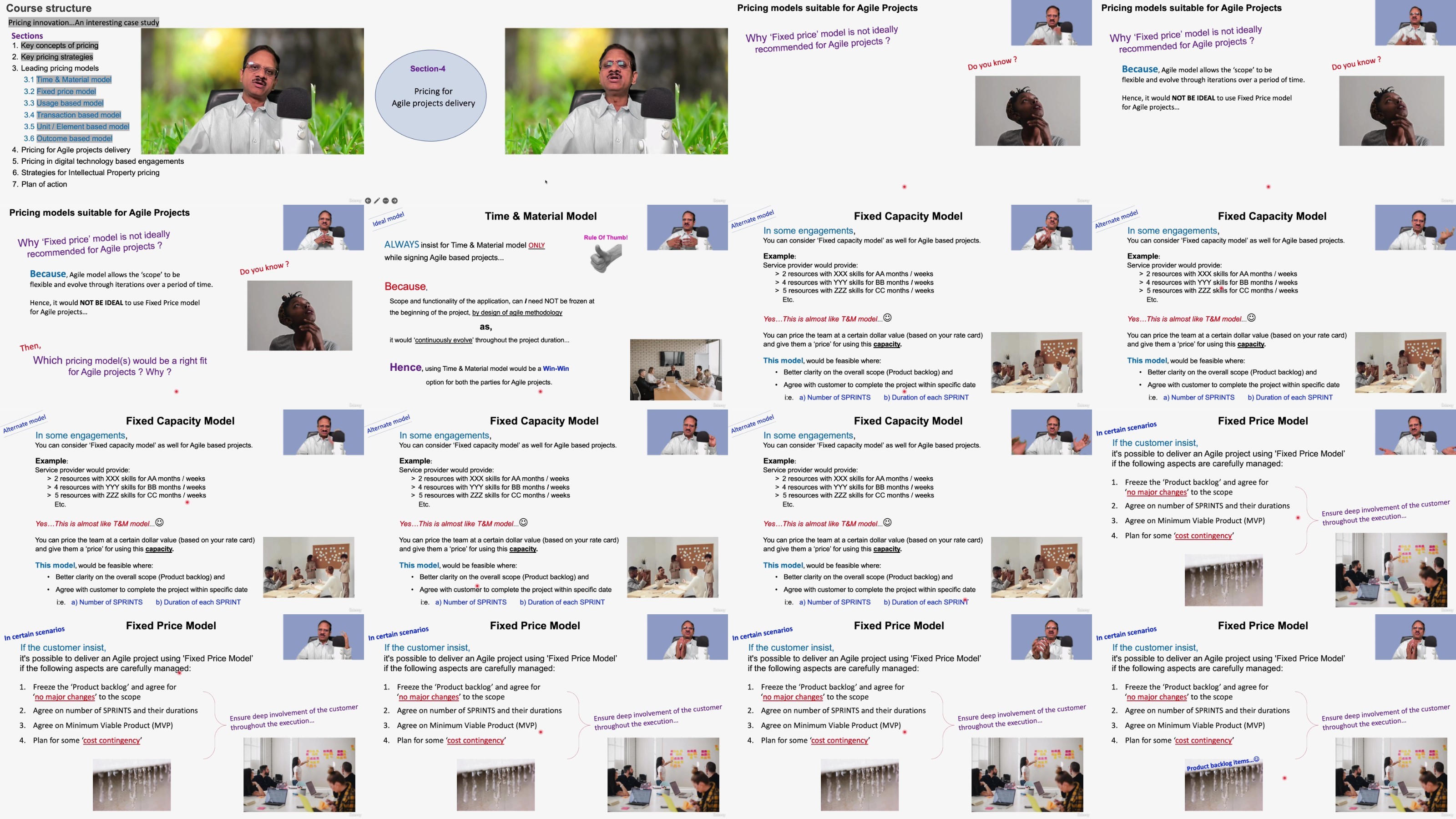
6. Gain clarity on the ideal pricing models for Agile engagements, with strong justification for their suitability.
7. Discover the leading strategies for effectively pricing intellectual properties
Requirements
Recommended Experience: At least 5 years in the IT services industry for optimal benefit.
Customer Interaction: Prior experience interacting with customers is beneficial for better relatability but not mandatory.
Requirements: A mobile device or PC with internet access
Tools: No specific tools or software required
Description
Overview
Section 1: Welcome to the course
Lecture 1 Brief profile of the faculty
Lecture 2 Course structure and coverage
Section 2: Pricing innovation: An interesting real-world case study
Lecture 3 An interesting real-world case study on innovative pricing
Section 3: Section-1: Key concepts of pricing
Lecture 4 1.1 True relationship between Price, Cost and Margin
Lecture 5 1.2 Low price Vs Premium price
Lecture 6 1.3 Factors considered in determining the ‘Rate card’
Lecture 7 1.4 Factors considered for computing the ‘Final price’
Lecture 8 1.5 Customer engagement maturity levels
Section 4: Section-2: Key pricing strategies
Lecture 10 2.1 An introduction to key pricing strategies
Lecture 11 2.2 Strategy-1: Cost based pricing
Lecture 12 2.3 Strategy-2: Competitive pricing
Lecture 13 2.4 Strategy-3: Value based pricing
Lecture 14 2.5 Strategy-4: Price skimming
Lecture 15 2.6 Strategy-5: Penetration pricing
Lecture 16 2.7 Prevalent pricing techniques
Section 5: Section-3: Leading pricing models for IT services
Lecture 17 Introduction to leading pricing models
Lecture 18 Pricing models for different engagement maturity levels
Section 6: Section-3.1: Time and Material pricing model
Lecture 19 3.1.1 Introduction to T&M pricing model
Lecture 20 3.1.2 Billing categories in T&M pricing model
Lecture 21 3.1.3 Advantages and Disadvantages for the customer
Lecture 22 3.1.4 Advantages and disadvantages for the service provider
Lecture 23 3.1.5 Dos and Don’ts for the service provider
Lecture 24 3.1.6 Key best practice in the T&M pricing model
Section 7: Section-3.2: Fixed Price model
Lecture 29 3.2.1 Introduction to Fixed Price model
Lecture 30 3.2.3 Advantages and disadvantages for the service provider
Lecture 31 3.2.4 Dos and Don’ts for the service provider
Lecture 34 3.2.2 Advantages and disadvantages for the customer
Lecture 36 3.2.8 ‘Open book’ system in the Fixed Price model
Section 8: Section-3.3: Usage-based pricing model
Lecture 37 3.3.1 Introduction to Usage-based pricing model
Lecture 38 3.3.2 Implementation of Usage-based pricing model
Lecture 39 3.3.3 Advantages and disadvantages for the customer
Lecture 40 3.3.4 Advantages and disadvantages for the Product vendors
Lecture 41 3.3.5 Dos and Don’ts for the Product vendors
Section 9: Section-3.4: Transaction-based pricing model
Lecture 44 3.4.1 Introduction to Transaction-based pricing model
Lecture 45 3.4.2 Advantages and disadvantages for the customer
Lecture 46 3.4.3 Advantages and disadvantages for the service provider
Lecture 47 3.4.4 Dos and Don’ts for the service provider
Lecture 48 3.4.5 Case study
Section 10: Section-3.5: Unit-Element-based pricing model
Lecture 49 3.5.1 Introduction to the Unit-Element-based pricing model
Lecture 50 3.5.2 Advantages and disadvantages for the customer
Lecture 51 3.5.3 Advantages and disadvantages for the service provider
Lecture 52 3.5.4 Dos and Don’ts for the service provider
Section 11: Section-3.6: Outcome-based pricing model
Lecture 56 3.6.1 What is Outcome-based pricing ?
Lecture 57 3.6.2 Why Outcome-based pricing ?
Lecture 58 3.6.3 Evaluate the suitability of an engagement for Outcome-based pricing
Lecture 59 3.6.4 Payment structure in Outcome-based pricing
Lecture 60 3.6.5 Roles & Responsibilities in Outcome-based engagements
Lecture 61 3.6.6 Categories of Outcome-based engagements
Lecture 62 3.6.7 Category-1: Support & Maintenance Case study
Lecture 63 3.6.8 Category-1: Development Case study
Lecture 64 3.6.9 Category-2: Case study: Save costs for the customer
Lecture 65 3.6.10 Category-2: Scenario-1: Pay X% as a fixed amt and Y% linked to outcome
Lecture 66 3.6.11 Category-2: Scenario-2: Share X% of the actual saved cost
Lecture 67 3.6.12 Category-3: Case study: Improve revenues-profits for the customers
Lecture 68 3.6.13 Category-3: Scenario-1: Pay X% as a fixed amt and Y% of actual revenue
Lecture 69 3.6.14 Category-3: Scenario-2: Share X% of the actual improved revenue
Lecture 70 3.6.15 Real world case study for outcome based pricing model
Section 12: Section-4: Pricing models for Agile projects
Lecture 71 Pricing models suitable for Agile projects
Section 13: Section-5: Pricing in Digital Technology-based engagements
Lecture 72 Pricing complexity in Digital Technology-based engagements
Lecture 73 3.6.15 Category-3: Real world case study for Outcome-based pricing model
Section 14: Section-5.1: Pricing in Mobile technologies
Lecture 74 5.1.1 Recommended pricing models for Mobile engagements
Lecture 75 5.1.2 Key factors impacting the pricing (Factor-1 to Factor-7)
Lecture 76 5.1.3 Key factors impacting the pricing (Factor-8 to Factor-14)
Section 15: Section-5.2: Pricing in Cloud technologies
Lecture 77 5.2.1 Recommended pricing models for Cloud engagements
Lecture 78 5.2.2 Key factors impacting the pricing (Factor-1 to Factor-4)
Lecture 79 5.2.3 Key factors impacting the pricing (Factor-5 to Factor-9)
Section 16: Section-5.3: Pricing in Big data technologies
Lecture 80 5.3.1 Recommended pricing models for Big data engagements
Lecture 81 5.3.2 Key factors impacting the pricing (Factor-1 to Factor-4)
Lecture 82 5.3.3 Key factors impacting the pricing (Factor-5 to Factor-8)
Section 17: Section-5.4: Pricing in Analytics technologies
Lecture 83 5.4.1 Recommended pricing models for Analytics engagements
Lecture 84 5.4.2 Key factors impacting the pricing (Factor-1 to Factor-4)
Lecture 85 5.4.3 Key factors impacting the pricing (Factor-5 to Factor-11)
Section 18: Section-5.5: Pricing in IoT technologies
Lecture 86 5.5.1 Recommended pricing models for IoT engagements
Lecture 87 5.5.2 Key factors impacting the pricing (Factor-1 to Factor-5)
Lecture 88 5.5.3 Key factors impacting the pricing (Factor-6 to Factor-10)
Lecture 89 5.6.1 Recommended pricing models for AI engagements
Lecture 90 5.6.2 Key factors impacting the pricing (Factor-1 to Factor-5)
Lecture 91 5.6.3 Key factors impacting the pricing (Factor-6 to Factor-8)
Lecture 92 5.6.4 Key factors impacting the pricing (Factor-9 to Factor-11)
Section 20: Section-6: Strategies for Intellectual Property pricing
Lecture 93 6.1 Introduction to Intellectual Property (IP) pricing
Lecture 94 6.2 Strategy-1: Cost-based valuation for IPs
Lecture 95 6.3 Strategy-2: income-based valuation for IPs
Lecture 96 6.4 Strategy-3: Market-based valuation for IPs
Section 21: Section-7: Plan of action
Lecture 97 Plan of action
Project Managers / Senior Project Managers,Delivery Managers / Delivery Heads,Program Managers,Sales and Pre-sales consultants,Quality consultants supporting IT services delivery,Anyone keen to gain in-depth knowledge of IT service delivery pricing
RapidGator
https://filecrypt.cc/Container/B704FCFF19.html
https://www.keeplinks.org/p27/679a6760d5360
AlfaFile
https://filecrypt.cc/Container/30ABA34497.html
https://www.keeplinks.org/p27/679a67a92c4c7
TurboBit
https://filecrypt.cc/Container/87021F8C24.html
https://www.keeplinks.org/p27/679a69b409c00