


Master Oauth 2.0: A Practical Guide To Api Security
Published 1/2025
MP4 | Video: h264, 1920×1080 | Audio: AAC, 44.1 KHz
OAuth 2.0 with practical flows, implementations, real-world use cases, and decision-making for robust API architectures
What you’ll learn
Learn OAuth 2.0 Token Types and Formats: Explore access tokens, refresh tokens, JWT, and opaque tokens to secure modern APIs.
Understand Token Validation Methods: Discover when to use local validation or introspection for efficient and secure token verification.
Choose the Right OAuth Client Type: Learn when to use public or confidential clients.
Define and Structure OAuth Scopes: Learn to name and structure OAuth scopes for effective, granular API access control.
Gain Basics of OIDC: Understand how OpenID Connect extends OAuth for user authentication and single sign-on.
Master User-Initiated Flows: Learn Implicit, Authorization Code, and PKCE flows for secure user authentication.
Explore Flow Challenges: Analyze vulnerabilities with real-world hacker scenarios and address them effectively.
Choose the Best Flow: Use decision trees to identify the ideal OAuth flow for your project needs.
Discover Advanced Flow Mechanisms: Learn JWT Secured Authorization Request (JAR), JWE, and Pushed Authorization Request (PAR) to enhance OAuth 2.0 security.
Implement Machine-to-Machine Flows: Learn the Client Credentials Flow for secure backend service communication.
Understand ROPC and Device Code Flows: Discover flows like Resource Owner Password Credentials and Device Code for resource owner and devices with limited input
Master Advanced Advanced Client Authentication Methods: Use JWT, SAML assertions, and X.509 mTLS for robust API security.
Learn mTLS X.509 Basics: Build foundational knowledge of mutual TLS, X.509 certificates, and Public Key Infrastructure (PKI).
Secure OAuth 2.0 Access Tokens: Protect your tokens with advanced FAPI-compliant mechanisms like mutual TLS and Demonstration of Proof-of-Possession (DPoP).
Connect with Legacy and SAML Systems: Integrate with legacy infrastructures and SAML for phased migrations.
Simulate Real-World Scenarios: Analyze attacker scenarios and explore diverse project architectures.
Make Informed Decisions: Use decision trees to select the best OAuth flows and mechanisms for secure architectures.
Requirements
A general understanding of HTTP concepts, such as methods (GET, POST), headers, and status codes.
This course is designed for both beginners and advanced learners, so no prior knowledge of OAuth 2.0 is required.
Description
Overview
Section 1: Course Introduction: Mastering OAuth 2.0 from Basics to Advanced
Lecture 1 Course Agenda and Structure
Lecture 2 Recommendations for Maximizing Your Learning Experience
Section 2: OAuth 2.0 Basics
Lecture 3 Introduction and Agenda for OAuth 2.0 Basics
Lecture 4 Why OAuth 2.0 is Essential: A Practical Story
Lecture 5 Understanding OAuth 2.0 Standard Flow Through a Real-World Scenario
Lecture 6 Understanding OAuth 2.0 Roles
Lecture 7 OAuth 2.0 Demo: Real-Life Application with Photopea and OneDrive
Lecture 8 Understanding OAuth 2.0 Client Types: Public vs. Confidential Clients
Lecture 12 Understanding OAuth 2.0: Access Token vs. Refresh Token
Lecture 18 Introduction to OpenID Connect (OIDC) and OAuth 2.0 Comparison
Lecture 19 OIDC in Action: Practical Flow and User Authentication
Lecture 20 Real-World Use Case Demo: OIDC Authentication with Photopea
Section 3: OAuth 2.0 User-Initiated Flows: Secure Authorization for Web and Mobile Apps
Lecture 21 Agenda: OAuth 2.0 User-Initiated Flows Overview
Lecture 22 Understanding the OAuth 2.0 Implicit Flow: A Step-by-Step Guide
Lecture 23 OAuth 2.0 Implicit Flow: Hacker Scenario and Security Challenges
Lecture 24 Understanding the OAuth 2.0 Authorization Code Flow: A Step-by-Step Guide
Lecture 25 OAuth 2.0 Authorization Code Flow: Hacker Scenarios and Security Challenges
Lecture 26 Understanding the OAuth 2.0 PKCE Flow: A Step-by-Step Guide
Lecture 27 OAuth 2.0 PKCE Flow: Hacker Scenarios and Security Enhancements
Lecture 28 Recap of OAuth 2.0 User-Initiated Flows and Decision Tree
Section 4: Advanced Security for User-Initiated OAuth 2.0 Flows
Lecture 29 Agenda: Advanced Security Extensions for OAuth 2.0 User-Initiated Flows
Lecture 30 OAuth 2.0 User-Initiated Flows: Hacker Scenario and Authorization Request Risks
Lecture 31 Understanding the JWT Secured Authorization Request (JAR) in OAuth 2.0
Lecture 32 The Limitation of JAR: Hacker Scenario and Security Challenges
Lecture 33 Asymmetric Encryption Explained: Ensuring Confidentiality in OAuth 2.0
Lecture 34 Enhancing OAuth 2.0 Security with JWE: Confidentiality in Authorization Requests
Lecture 35 OAuth 2.0 Pushed Authorization Requests (PAR): Simplified and Secure
Lecture 36 Combining OAuth 2.0 Security Extensions: PAR, JAR, and JWE
Lecture 37 OAuth 2.0 Security Extensions: Recap, Use Cases, and Decision Tree
Section 5: Understanding OAuth 2.0 ROPC Flow: Risks and When to Use It
Lecture 38 Exploring the OAuth 2.0 ROPC Flow: Use Cases and Risks
Section 6: OAuth 2.0 Machine-to-Machine (M2M): Mastering the Client Credentials Flow
Lecture 39 Mastering the OAuth 2.0 Client Credentials Flow: Use Cases and Decision Tree
Section 7: Mastering OAuth 2.0 Device Code Flow for Limited-Input Devices
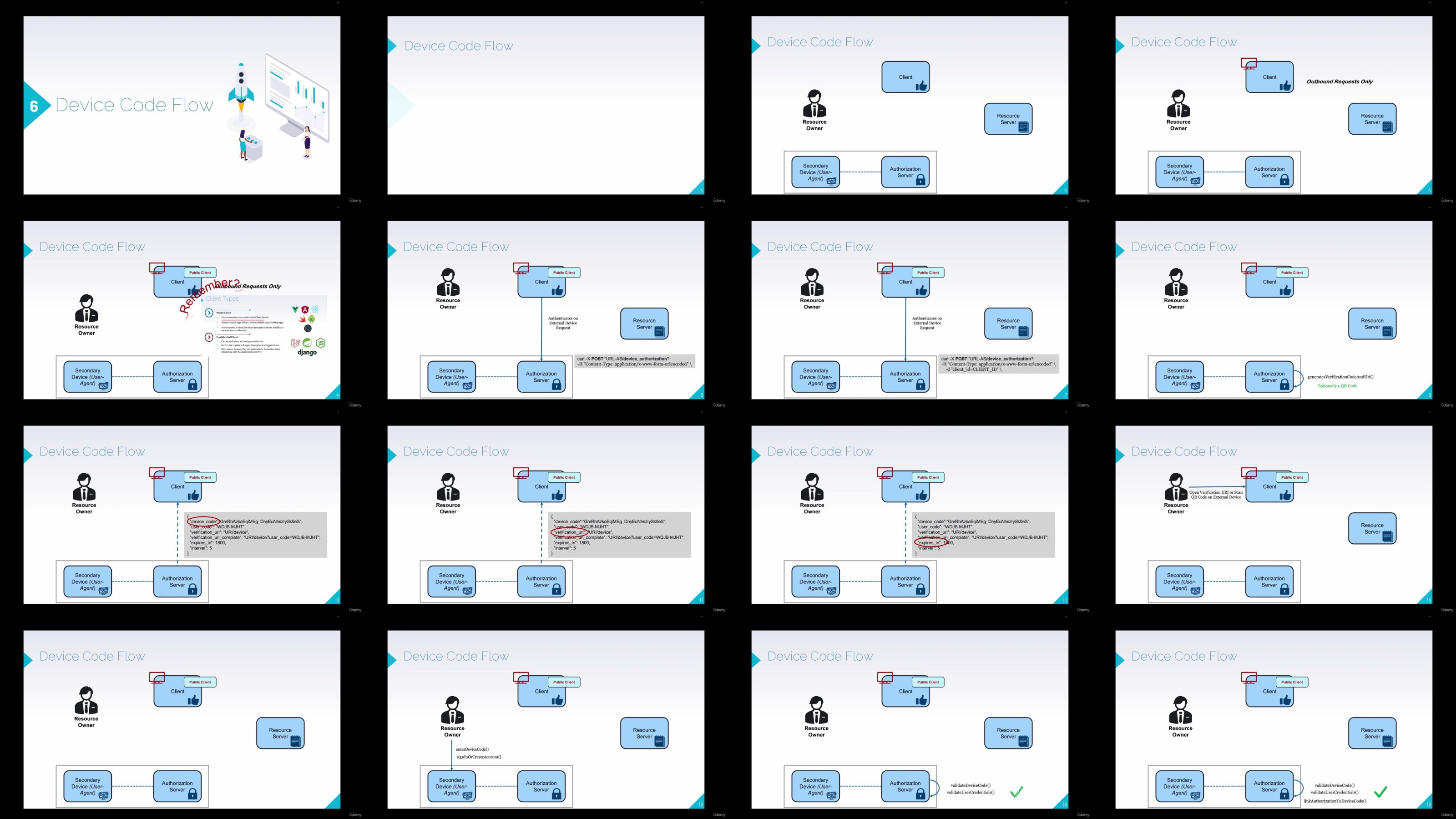
Lecture 40 Understanding the OAuth 2.0 Device Code Flow: A Step-by-Step Guide
Section 8: Integrating External Identity Providers with OAuth 2.0 Using JWT and SAML
Lecture 41 Introduction to OAuth 2.0 Assertion Flows: JWT and SAML
Lecture 42 Exploring the OAuth 2.0 JWT Bearer Assertion Flow
Lecture 43 Understanding the OAuth 2.0 SAML Bearer Assertion Flow
Lecture 44 OAuth 2.0 Assertion Flows: Use Cases for JWT and SAML Integration
Section 9: OAuth 2.0 Advanced Client Authentication Methods
Lecture 45 Introduction to OAuth 2.0 Advanced Client Authentication Methods
Lecture 46 Client Authentication in OAuth 2.0 Using Client Secret
Lecture 47 Client Authentication in OAuth 2.0 Using JWT Bearer Assertion
Lecture 48 Client Authentication in OAuth 2.0 Using SAML Bearer Assertion
Lecture 51 Choosing the Right OAuth 2.0 Client Authentication Method: Recap and Use Cases
Section 10: OAuth 2.0 Advanced Token Security Mechanisms: X.509 mTLS and DPoP
Lecture 52 Introduction to Advanced OAuth 2.0 Token Security: X.509 mTLS and DPoP
Lecture 53 OAuth 2.0 Access Token Binding with X.509 mTLS (Mutual TLS)
Lecture 54 OAuth 2.0 Access Token Binding with DPoP (Proof-of-Possession)
DDownload
https://www.keeplinks.org/p27/6872343395453
https://ddownload.com/xybqd02k29bk/yxusj.Udemy.-.Master.OAuth.2.0.A.Practical.Guide.to.API.Security.1080.rar
RapidGator
https://www.keeplinks.org/p27/6872353e8c213
https://rapidgator.net/file/274462b56cf30092e4b3852fd8c27d1c/yxusj.Udemy.-.Master.OAuth.2.0.A.Practical.Guide.to.API.Security.1080.rar
NitroFlare
https://www.keeplinks.org/p27/6872359058bce
https://nitroflare.com/view/1CCCD4520FD17ED/yxusj.Udemy.-.Master.OAuth.2.0.A.Practical.Guide.to.API.Security.1080.rar