


MasterClass – Chris Hadfield Teaches Space Exploration
01. Introduction
Meet your instructor: Chris Hadfield, retired astronaut and former Commander of the International Space Station. In his first lesson, Chris reflects on overcoming the impossible to explore outer space.
02. Astronaut Training
To become an astronaut, you have to become an expert on everything. Chris outlines the scope of an astronaut’s training from leadership skills to survival skills.
03. Rockets: How Rockets Work
04. Rockets: What It Feels Like to Launch
05. Rockets: Atmospheric Drag
Chris breaks down the equation for drag and shows how rockets are designed to overcome the biggest hurdle of launching into space-the atmosphere.
06. Rockets: Orbital Mechanics
Chris uses familiar situations-like driving a car and jumping off a diving board-to illustrate how the laws of orbital mechanics govern spaceflight and navigation
07. Rockets: Fuels and Propulsion
Chris explains the pros and cons of different types of rocket fuels including liquid fuel, solid fuel, and ionized gas.
08. Rockets: The Price of Exploration
"Rockets and spaceflight are dangerous by definition. Learn how astronauts manage their fears and cope with tragedy as Chris had to do after the loss of a friend in the Columbia Space Shuttle mission. "
09. Spaceships: Capsule Design
Learn the virtues and drawbacks of using the capsule model for human transport to space as Chris analyzes the designs of the Apollo, Gemini, Lunar Lander, and Soyuz.
10. Spaceships: Shuttles and Beyond
Two-thirds of those who’ve flown to space got there on a Space Shuttle. Chris outlines the design of the Shuttle, the impact of its reusability, and how spacecraft will evolve in the future.
Learn how astronauts use stars, planets, and instruments to understand where their spaceship is, how it’s oriented, and where it’s going.
12. Spaceships: Navigating to the International Space Station
“It’s kind of like an elephant ballet.” Chris talks you through the process of flying your spaceship to the ISS, docking, and beginning your adventure aboard the laboratory in the sky.
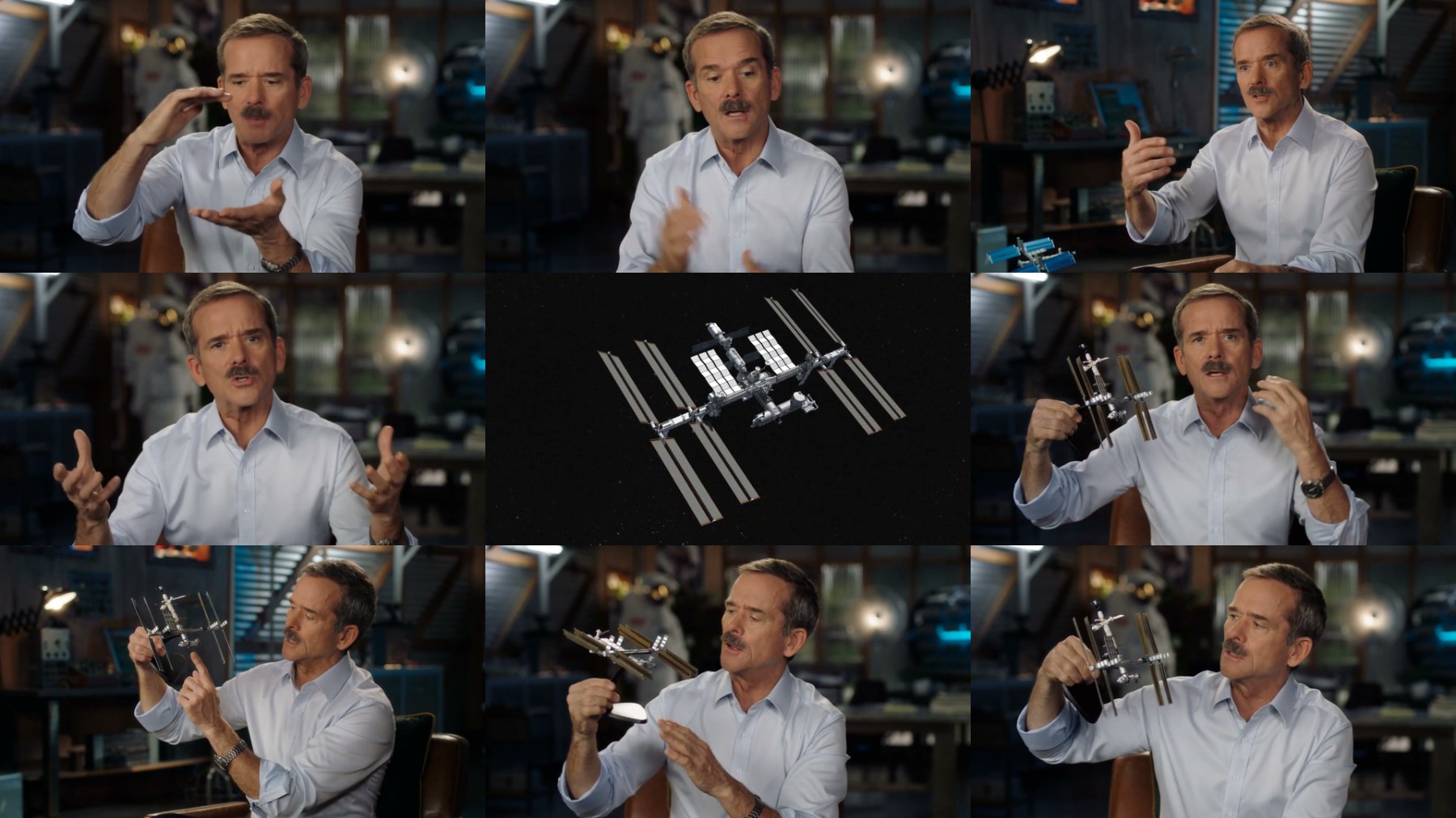
13. The ISS: Conception, Design, and Construction
The International Space Station couldn’t have been built without teams coming together from around the world. Chris details the process of constructing the ISS and explains the idea of shared exploration.
14. The ISS: Life Support Systems
Learn about the many systems that work together to keeps astronauts alive aboard the ISS and how those systems are evolving so that we can travel even further in space.
15. The ISS: Experiments
16. Leadership: Commanding the ISS
Chris describes the great honor and responsibility of commanding the ISS, ranks the commander’s priorities, and outlines what it takes to reach and fulfill such an elite and difficult leadership position.
17. Training and Learning: One-Pagers
Preparing for space travel means learning massive amounts of information. Learn how Chris used a series of one-page summaries to recall complex systems and concepts on the fly during his time in space.
18. Comms: Mission Control Evolution and Operations
The first words spoken from the Moon were directed to Mission Control for a reason. Learn how Mission Control functions and why it is so critical to the success of a mission to space.
19. Spacewalking: Spacesuits
Chris gives a head-to-toe tour of an EMU (Extravehicular Mobility Unit), explaining how it keeps astronauts alive while spacewalking and conducting work outside the ship.
20. Spacewalking: Spacewalks
21. Spacewalking: Training
Chris describes his personal experience training for spacewalking in an underwater simulation and emphasizes the importance of gaining confidence in maneuvering and monitoring the spacesuit.
22. Spacewalking: Space and Perspective
23. Training and Learning: Simulations
Chris teaches you the principles behind simulation setup, the mindset you need to learn as much as possible from simulations, and how astronauts prepare for worst-case scenarios.
24. Mars: How to Get to Mars
Chris explains the technical and societal challenges we face in traveling to Mars, including the ideal flight path required, the physics of slowing down and landing, and the risk of human life.
25. Mars: Living on Another Planet
Chris walks through the basic human needs required to live on another planet. Learn what it takes to grow food in space, protect ourselves from the elements, and readjust to gravity.
26. Mars: In-Situ Resource Utilization
If we can safely get to Mars, in-situ resource utilization could help us sustain life there. Chris breaks down the vital Sabatier process for creating hydrogen, oxygen, and methane on Mars.
27. Mars: Exploring Mars, Geology, and Astrobiology
Chris discusses how finding life on Mars could deepen our understanding of the universe and illuminate our place within it. Learn how we’re working with robots to search for life and build an outpost on Mars.
28. Conclusion: The Future of Exploration
29. Bonus Chapter: Chris’s Journey
Chris tells his personal story of becoming an astronaut and gives advice for achieving your goals-no matter where life takes you.
More Info
RapidGator
https://www.keeplinks.org/p27/6a66ae06b1b6c
NitroFlare
https://www.keeplinks.org/p27/6a66af964a5cb
UsersDrive