

Microelectronics – Biasing Concept in MOS Amplifiers
Published 4/2025
Duration: 1h 37m | .MP4 1280×720, 30 fps(r) | AAC, 44100 Hz, 2ch | 805 MB
Biasing in MOS Analog Circuits
What you’ll learn
– Develop a deep understanding of MOS amplifier biasing using resistive-divider, self-biasing, and current mirror techniques for reliable analog design.
– Expect to master key biasing methods, link DC analysis to amplifier behavior, and gain intuition to apply biasing schemes in real-world analog circuits.
Requirements
– Udemy Audio Course on "Microelectronics – MOS Device Physics"
Description
This audiobook course,Fundamentals of Microelectronics Circuits – Biasing in MOS Amplifiers, provides an in-depth, audio-friendly exploration of essential biasing strategies used in MOS amplifier design. Biasing is one of the most fundamental concepts in analog circuit design, as it determines the operating region of a MOSFET and sets the stage for linear amplification. This course is crafted to help students and practitioners develop a strong intuition for how to establish stable and reliable operating points for MOS transistors across a wide range of applications.
The course introduces the concept of the DC operating point-or quiescent point-which defines the steady-state behavior of the transistor and ensures that the amplifier operates in the saturation region for small-signal applications.
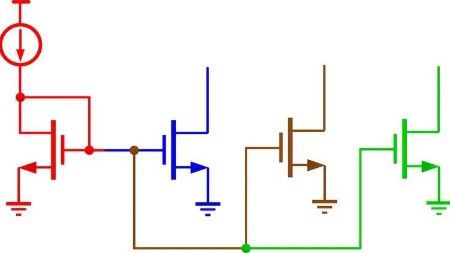
The course also coversself-biasing configurations, where the gate and drain voltages are interrelated through feedback established via passive elements, enabling a compact and robust biasing scheme with minimal component count. Additionally, we explorebiasing using current mirrors, a widely adopted technique in integrated circuits that facilitates accurate and consistent current referencing across multiple circuit branches. This method is critical in differential amplifiers and multi-stage analog blocks.
Rather than simply describing the circuits, the course emphasizes conceptual clarity through intuitive reasoning, circuit walkthroughs, and voice-guided problem-solving. Verbal explanations walk listeners through KVL/KCL analyses, the role of MOSFET parameters in setting the bias point, and the influence of component choices on headroom, power consumption, and stability.
To reinforce learning, the course features step-by-step audio derivations of bias conditions, using small-signal models where needed to build links between DC analysis and subsequent amplifier behavior. This approach helps bridge the gap between textbook theory and practical circuit intuition.
By the end of the course, learners will have a firm grasp of how to implement and evaluate different MOS biasing techniques. They’ll understand when and why to choose one method over another, and how these biasing methods form the backbone of high-performance analog designs.
Who this course is for:
– Undergraduate and Graduate Students, Analog and Digital Design Engineers
More Info
Please check out others courses in your favourite language and bookmark them
– – – –

DDownload
https://www.keeplinks.org/p27/683342e5f0f8e
https://ddownload.com/witz1g7afp2k/yxusj.Microelectronics.-.Biasing.Concept.in.MOS.Amplifiers.rar
RapidGator
https://www.keeplinks.org/p27/6833441e1e90a
https://rapidgator.net/file/05fe628f6e08d487f58c3edc8e3ec228/yxusj.Microelectronics.-.Biasing.Concept.in.MOS.Amplifiers.rar
NitroFlare
https://nitroflare.com/view/E419190FAD98D4A/yxusj.Microelectronics.-.Biasing.Concept.in.MOS.Amplifiers.rar