

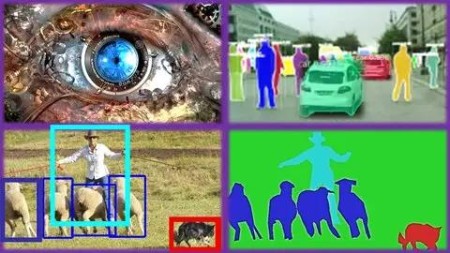
Modern Computer Vision & Deep Learning With Python & Pytorch
Published 7/2023
MP4 | Video: h264, 1280×720 | Audio: AAC, 44.1 KHz
Computer Vision with Python using Deep Learning for Classification, Instance & Semantic Segmentation, & Object Detection
What you’ll learn
Learn Computer Vision and Deep Learning with Real-world Applications in Python
Learn Deep Convolutional Neural Networks (CNN) for Computer Vision
Computer Vision for Single and Multi-label Classification with Python and Pytorch
Computer Vision for Image Semantic Segmentation with Python and Pytorch
Computer Vision for Image Instance Segmentation with Python and Pytorch
Computer Vision for Object Detection with Python and Pytorch
Google Colab with GPU for Writing Python and Pytorch Code
Learn Data Augmentation with Different Image Transformations
Custom Datasets for Image Classification, Image Segmentation and Object Detection
Hyperparameters Optimization of Deep Learning Models to Improve Performance
Learn Performance Metrics (Accuracy, IOU, Precision, Recall, Fscore)
Transfer Learning with Pretrained Models of Deep Learning in Pytorch
Train Image Segmentation, Classification and Object Detection Models on Custom Datasets
Evaluate and Deploy Image Segmentation, Image Classification and Object Detection Models
Perform Object Detection using RCNN, Fast RCNN, Faster RCNN Models with Python and Pytorch
Perform Semantic Segmentation with UNet, PSPNet, DeepLab, PAN, and UNet++ Models with Pytoch and Python
Perform Instance Segmentation using Mask RCNN on Custom Dataset with Pytorch and Python
Perform Image Single and Multi-label Classification using Deep Learning Models (ResNet, AlexNet) with Pytorch and Python
Visualization of Results, Datasets, and Complete Python/Pytorch Code is Provided for Classification, Segmentation, and Object Detection
Requirements
Computer Vision and Deep Learning with Python and Pytorch is taught in this course by following a complete pipeline from Zero to Mastery
No prior knowledge of Computer Vision and Deep Learning is assumed. Everything will be covered with hands-on trainings
Description
Overview
Section 1: Introduction
Lecture 1 Introduction to Course
Section 2: What is Computer Vision & its Applications
Lecture 2 Introduction to Computer Vision and its Real-world Applications
Lecture 3 Major Computer Vision Tasks
Section 3: Deep Convolutional Neural Networks (CNN) for Computer Vision
Lecture 4 Introduction to Convolutional Neural Networks (CNN)
Section 4: Setting-up Google Colab for Writing Python Code
Lecture 5 Introduction to Google Colab for Python Coding
Lecture 6 Connect Google Colab with Google Drive
Section 5: Image Classification Task of Computer Vision
Lecture 7 Introduction to Single and Multi-label Image Classification
Section 6: Pretrained Models for Single and Multi-Label Image Classification
Lecture 8 Introduction to Pretrained Models
Lecture 9 Deep Learning ResNet and AlexNet Architectures
Lecture 10 Access Data from Google Drive to Colab
Lecture 11 Data Preprocessing for Image Classification
Lecture 12 Single-Label Image Classification using ResNet and AlexNet PreTrained Models
Lecture 13 Single Label Classification Python and Pytorch Code
Lecture 14 Multi-Label Image Classification using Deep Learning Models
Lecture 15 Multi-Label Classification Python and PyTorch Code
Section 7: Transfer Learning for Image Classification
Lecture 16 Introduction to Transfer Learning
Lecture 17 Dataset, Data Augmentation, and Dataloaders
Lecture 18 Dataset for Classification
Lecture 19 FineTuning Deep ResNet Model
Lecture 20 HyperParameteres Optimization for Model
Lecture 21 Training Deep ResNet Model
Lecture 22 Fixed Feature Extractraction using ResNet
Lecture 23 Model Optimization, Training and Results Visualization
Lecture 24 Complete Python Code for Transfer Learning and Dataset
Section 8: Semantic Segmentation Task Of Computer Vision
Lecture 25 Introduction to Semantic Image Segmentation
Lecture 26 Semantic Segmentation Real-World Applications
Section 9: Deep Learning Architectures For Segmentation (UNet, PSPNet, PAN)
Lecture 27 Pyramid Scene Parsing Network (PSPNet) For Segmentation
Lecture 28 UNet Architecture For Segmentation
Lecture 29 Pyramid Attention Network (PAN)
Lecture 30 Multi-Task Contextual Network (MTCNet)
Section 10: Segmentation Datasets, Annotations, Data Augmentation & Data Loading
Lecture 31 Datasets for Semantic Segmentation
Lecture 32 Data Annotations Tool for Semantic Segmentation
Lecture 33 Data Loading with PyTorch Customized Dataset Class
Lecture 34 Data Loading for Segmentation with Python and PyTorch Code
Lecture 35 Data Augmentation using Albumentations with Different Transformations
Lecture 36 Augmentation Python Code
Lecture 37 Learn To Implement Data Loaders In Pytorch
Section 11: Performance Metrics (IOU) For Segmentation Models Evaluation
Lecture 38 Performance Metrics (IOU, Pixel Accuracy, Precision, Recall, Fscore)
Lecture 39 Code (Python and PyTorch)
Section 12: Encoders and Decoders For Segmentation In PyTorch
Lecture 40 Transfer Learning And Pretrained Deep Resnet Architecture
Lecture 41 Encoders for Segmentation with PyTorch Liberary
Lecture 42 Decoders for Segmentation in PyTorch Liberary
Section 13: Implementation, Optimization and Training Of Segmentation Models
Lecture 43 Implement Segmentation Models (UNet, PSPNet, DeepLab, PAN, and UNet++)
Lecture 44 Segmentation Models Code with Python
Lecture 45 Learn To Optimize Hyperparameters For Segmentation Models
Lecture 46 Model Optimaztion Code (Python And PyTorch)
Lecture 47 Training of Segmentation Models
Lecture 48 Model Training Code (Python And PyTorch)
Section 14: Test Models and Visualize Segmentation Results
Lecture 49 Test Models and Calculate IOU,Pixel Accuracy,Fscore
Lecture 50 Test Models and Calculate Performance Scores (Python Code)
Lecture 51 Visualize Segmentation Results and Generate RGB Segmented Map
Lecture 52 Segmentation Results Visualization (Python Code)
Section 15: Complete Code and Dataset for Semantic Segmentation
Lecture 53 Final Code Review
Lecture 54 Complete Code and Dataset is Attached
Section 16: Object Detection Task Of Computer Vision
Lecture 55 Object Detection and its Applications
Section 17: Deep Learning Architectures for Object Detection (R-CNN Family)
Lecture 56 Deep Convolutional Neural Network (VGG, ResNet, GoogleNet)
Lecture 57 RCNN Deep Learning Architectures for Object Detection
Lecture 58 Fast RCNN Deep Learning Architectures for Object Detection
Lecture 59 Faster RCNN Deep Learning Architectures for Object Detection
Section 18: Detectron2 for Ojbect Detection
Lecture 60 Detectron2 for Ojbect Detection with PyTorch
Lecture 61 Perform Object Detection using Detectron2 Pretrained Models
Lecture 62 Python and PyTorch Code
Section 19: Training, Evaluating and Visualizing Object Detection on Custom Dataset
Lecture 63 Custom Dataset for Object Detection
Lecture 64 Dataset for Object Detection
Lecture 65 Train, Evaluate Object Detection Models & Visualizing Results on Custom Dataset
Lecture 66 Python and PyTorch Code
Section 20: Complete Code and Custom Dataset for Object Detection
Lecture 67 Resources: Code and Custom Dataset for Object Detection
Section 21: Instance Segmentation Task of Computer Vision
Lecture 68 What is Instance Segmentation
Section 22: Mask RCNN for Instance Segmentation
Lecture 69 Mask RCNN for Instance Segmentation
Section 23: Training, Evaluating and Visualizing Instance Segmentation on Custom Dataset
Lecture 70 Train, Evaluate Instance Segmentation Model & Visualizing Results on Custom Data
Section 24: Complete Code and Custom Dataset for Instance Segmentation
Lecture 71 Resources: Complete Code and Custom Dataset for Instance Segmentation

DDownload
https://www.keeplinks.org/p27/6988b61a17d02
RapidGator
https://www.keeplinks.org/p27/6988b76c9208f
NitroFlare
https://www.keeplinks.org/p27/6988b8f8713d7