

Oracle Pl/Sql Is My Game: Exam 1Z0-149
Last updated 5/2024
MP4 | Video: h264, 1920×1080 | Audio: AAC, 44.1 KHz
Become Oracle PL/SQL Developer / Covers ORACLE university track 100%. All the presentations & scripts are attached
What you’ll learn
The full track of Oracle university Exam 1Z0-144 : Program with PL/SQL
Oracle Database 12c Architecture
Downloading and installing oracle database 12c in details
Overview of PLSQL
Writing executable statements
Interacting with Oracle DB Server
Writing Control structure
Working with Composite Data Types
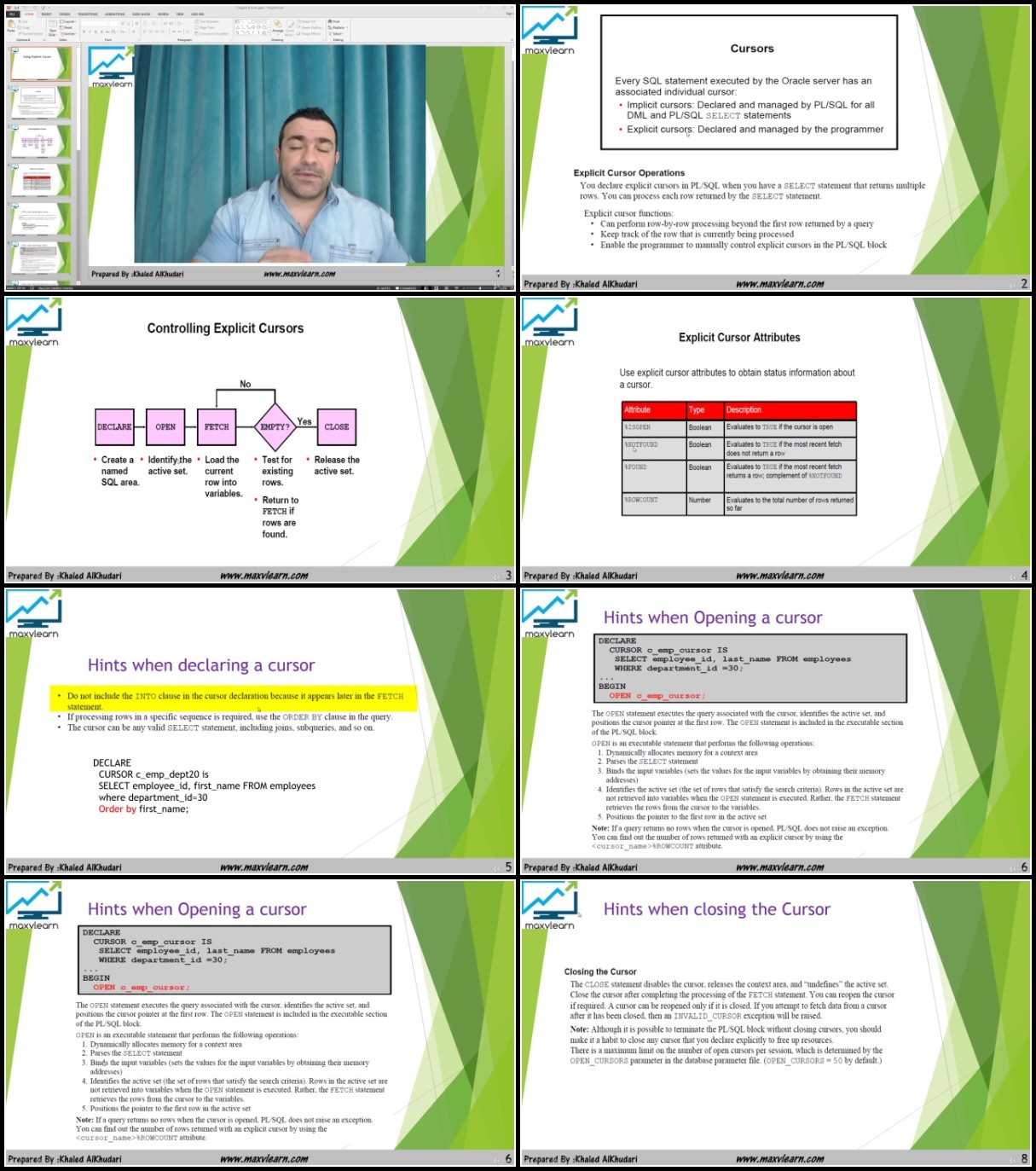
Using explicit cursors
Handling Exceptions
Creating Procedures
Creating Functions
Creating Packages
Working with Packages
Using oracle-supplied Packages in Application Development
Using dynamic SQL
Design consideration for PLSQL Code
Creating triggers
Creating Compound, DDL, and Event Database Triggers
Using the PLSQL Compiler
Managing PLSQL Code
Managing Dependencies
Requirements
You should know Oracle SQL ( 11g or 12c)
You should have strong knowledge in (SELECT statement, DML, DDL, DCL, creating views, indexes, and synonyms)
Windows Operating system is preferred, but this is not mandatory if you have the knowledge of downloading Oracle database on other OS
Downloading oracle database and this will be covered in details on Windows OS.
Description
This is one of the most amazing Udemy courses in Oracle PLSQL.The course covers the oracle university track 100% for :Exam Number: 1Z0-149 : Program with PL/SQLI designed in this course in a very professional structure that includes huge amount of exercises and examples.Be sure that you will become expert in PLSQL programming after finishing this course, and you will be ready 100% to pass the Oracle Exam. You will find all the presentations and all the SQL scripts attached in every chapter, so no need to waste your time repeating any example I did.Simply this course is the best..
Overview
Section 1: Course Setup
Lecture 1 Course Agenda
Lecture 2 Course Setup Notes / 4 Options
Lecture 3 Option 2- creating the HR Schema
Lecture 11 Option 4- Installing Oracle 11g express Edition + Unlock HR
Lecture 12 About Oracle 18c express edition
Lecture 13 HR Schema in this Course
Lecture 14 Navigate HR schema
Section 2: Overview of PL/SQL
Lecture 15 What is PL/SQL? What is the benefits?
Lecture 16 PL/SQL Block Structure & Types of Blocks
Lecture 17 Writing simple Anonymous block
Lecture 18 Using SQL*plus to run anonyms block
Lecture 19 Creating Script and run it
Lecture 23 Delimiters in string literals (the q’ Notation)
Lecture 26 Data Types exercise
Lecture 28 Understating the SELECT statement in PL/SQL
Section 4: Writing executable statements
Lecture 30 Inside PL/SQL Block
Lecture 31 Inside PL/SQL Block (exercise)
Lecture 32 Nested Blocks
Lecture 33 SQL & PL/SQL programing Guidelines
Section 5: Interacting with Oracle DB Server
Lecture 34 SELECT statement & DML in PL/SQL
Lecture 35 SELECT statement & DML in PL/SQL exercise
Lecture 36 Understanding Implicit SQL cursor/ SQL Attributes
Lecture 37 Implicit SQL cursor exercise
Section 6: Writing Control structure
Lecture 40 Handling nulls in IF statement
Lecture 41 CASE expression & CASE Statement
Lecture 42 Basic Loop
Lecture 43 While Loop
Lecture 44 FOR Loop
Lecture 45 Nested Loops
Lecture 46 Nested Loops and Labels
Lecture 47 Continue Statement
Section 7: Working with Composite Data Types
Lecture 50 PL/SQL Records: %ROWTYPE method
Lecture 51 Nested PL/SQL Records
Lecture 52 INDEX BY tables (Associative arrays)
Lecture 53 INDEX BY tables Methods
Lecture 54 INDEX BY tables of Records
Lecture 55 nested table
Lecture 56 Varray
Section 8: Using explicit cursors
Lecture 57 Understanding Explicit Cursor
Lecture 58 Explicit Cursor exercise
Lecture 59 Explicit Cursor Attributes
Lecture 60 FOR LOOP Cursor
Lecture 61 Cursor with Parameters
Lecture 62 FOR UPDATE Clause & CURRENT OF Clause
Section 9: Handling Exceptions
Lecture 63 Understanding Exceptions
Lecture 64 Predefined Oracle Server Error Exception
Lecture 65 Common mistakes when dealing with exceptions
Lecture 66 Non-Predefined Oracle Server Error Exception
Lecture 67 User-Defined Error Exception
Lecture 68 Group Functions and exceptions
Lecture 69 Many blocks and many exceptions
Section 10: Creating Procedure
Lecture 70 Understanding Procedures and subprograms
Lecture 71 Understanding Procedures Syntax
Lecture 72 Creating Procedure (IN parameter)
Lecture 73 Creating Procedure (OUT parameter)
Lecture 74 Creating Procedure (IN OUT parameter)
Lecture 75 Comparing the Paramter Modes
Lecture 76 Available notations for passing parameters
Lecture 77 Using the default option for Parameters
Lecture 78 Exception handling in multiple blocks
Lecture 79 Using Boolean and PL/SQL records as parameters
Section 11: Creating Functions
Lecture 80 Understanding user-defined functions
Lecture 81 Difference between procedures & functions
Lecture 82 Creating function example
Lecture 83 No_data_found and functions
Lecture 84 Advantages of user-defined functions in SQL Statements
Section 12: Creating Packages
Lecture 87 Understanding packages by nice example
Lecture 88 More about packages
Lecture 89 Creating package practice
Lecture 90 Creating package specification without body
Lecture 91 Guidelines for writing packages
Lecture 92 The visibility of a package’s components
Lecture 93 When & Why to recompile the package?
Section 13: Working with Packages
Lecture 94 Understanding Overloading Subprograms in PL/SQL
Lecture 95 Overloading Subprograms practices (procedures)
Lecture 96 Overloading Subprograms practices (functions)
Lecture 97 Overloading Standard package
Lecture 98 Forward Declaration
Lecture 99 Persistent State of packages
Lecture 100 Using PRAGMA SERIALLY_REUSABLE
Lecture 101 Persistent State and cursor
Lecture 102 using pl/sql tables in packages
Section 14: Using oracle-supplied Packages in Application Development
Lecture 103 About oracle-supplied Packages
Lecture 111 UTL_MAIL
Lecture 112 UTL_MAIL.send
Lecture 113 utl_mail.send_attach_raw
Lecture 114 utl_mail.send_attach_varchar2
Section 15: Using Dynamic SQL
Lecture 115 Execution flow of SQL
Lecture 116 what is Dynamic SQL?
Lecture 117 Execute immediate example 1 / delete any table
Lecture 118 Execute immediate example 2 / DDL in PLSQL
Lecture 119 Execute immediate example 3 / USING Clause
Lecture 120 Execute immediate example 4 / INTO Clause
Lecture 121 Execute immediate example 5 / single row query
Lecture 122 What is REF Cursor ?
Lecture 123 Dynamic SQL with multi row query
Lecture 124 Execute immediate/ more examples
Lecture 125 DBMS_SQL Package VS Execute immediat
Section 16: Design consideration for PLSQL Code
Lecture 128 Definer’s Rights
Lecture 129 Invoker’s Rights
Lecture 130 Autonomous Transactions
Lecture 131 Features Autonomous Transactions
Lecture 132 The (IN) parameters always passed by reference
Lecture 133 The (out/in out) parameters can be passed by value or reference
Lecture 134 Passing by reference example (IN parameters)
Lecture 135 Passing by value VS passing by reference using nocopy
Lecture 136 When Does NOCOPY hint has no effects?
Lecture 137 NOCOPY Performance Exercise
Lecture 138 Using the PARALLEL_ENABLE hint
Lecture 139 Using the RESULT_CACHE hint
Lecture 140 Using the DETERMINISTIC hint
Lecture 141 Understanding Bulk Binding
Lecture 142 Bulk Binding Example
Lecture 145 Understanding Bulk collect
Lecture 146 Bulk collect another example
Lecture 147 Bulk collect and cursors
Lecture 148 using returning in bulk collect
Lecture 149 INDICES OF
Section 17: Creating triggers
Lecture 150 Understanding Triggers
Lecture 151 Tirgger Types/ Trigger Event Types
Lecture 154 Triggers common cases
Lecture 155 Statement Level trigger Example 1
Lecture 156 Statement Level trigger Example 2
Lecture 157 Understanding the NEW & OLD qualifiers
Lecture 158 Row level trigger example
Lecture 159 Row level trigger (create Audit table)
Lecture 160 Trigger Firing sequence
Lecture 161 Compile/enable/ disable/ drop trigger
Lecture 162 Using the triggers for populating a default value
Lecture 163 Instead of triggers ( on Views)
Section 18: Creating Compound, DDL, and Event Database Triggers
Lecture 164 Follows Statement in triggers
Lecture 165 Understanding Compound triggers
Lecture 166 Understanding Mutating Table
Lecture 167 Solving Mutating Table issue using compound trigger
Lecture 168 Using Compound trigger & array to solve Mutating
Lecture 169 Mutating table & ON DELETE CASCADE
Lecture 170 Database Triggers VS Stored procedures
Lecture 171 Creating DDL triggers ( Schema or Database )
Lecture 172 Create system event trigger
Lecture 173 Final comments about the triggers
Section 19: Using the PLSQL Compiler
Lecture 174 Introduction about PL/SQL compiler
Lecture 175 Understanding ( Plsql_code_type ) parameter
Lecture 176 Understanding ( plsql_optimize_level ) parameter
Lecture 177 Understanding Warnings in PL/SQL
Lecture 178 Understanding (plsql_warnings) parameter
Lecture 179 More examples for plsql_warnings
Lecture 180 using the package dbms_warning
Section 20: Managing PLSQL Code
Lecture 181 Understanding conditional compilation
Lecture 182 Understanding (dbms_db_version ) package
Lecture 183 conditional compilation examples
Lecture 187 plsql_ccflags Real example
Lecture 188 Understanding Obfuscation
Lecture 189 dbms_ddl.create_wrapped
Section 21: Managing Dependencies
Lecture 192 Understanding dependencies
Lecture 193 Impact of changing referenced object
Lecture 194 Example of changing referenced object
Lecture 195 Query the Direct and indirect dependencies 1
Lecture 196 Query the Direct and indirect dependencies 2
Lecture 197 Objects could have 4 statuses
Lecture 198 Understanding invalidation of Dependent Objects
Lecture 199 Invalidation of Dependent Objects Example
Lecture 200 Impact of adding/altering the referenced object on the View
Lecture 201 Impact of adding/altering the referenced object on the function
Lecture 202 Impact of adding/altering the referenced object on the procedure
Lecture 208 Guidelines for reducing invalidation
Lecture 209 Understanding Remote Dependencies
Lecture 210 Understanding Database link
Lecture 211 Creating new pluggable DB & DB link
Lecture 212 Remote Dependencies & time stamp
Lecture 213 Example: Remote Dependencies & time stamp
Lecture 214 Example: Remote Dependencies & Signature mode
Section 22: Bonus Section
Lecture 215 permanent solution for ORA-01033 oracle initialization or shutdown in progress
Lecture 216 DML logs using package dbms_errlog
Lecture 217 Move your skills to Oracle Analytic Functions In-Depth & Advanced Oracle SQL
Lecture 221 About oracle apex
Students who wants to be expert in PL/SQL programming,Students who wants to be certified in PL/SQL,Fresh and junior programmers who need to find better jobs by gaining oracle certification,Students who already know Oracle SQL and they need to move to next level which is PL/SQL
AusFile
https://www.keeplinks.org/p27/67f6fc1c1de30
DDownload
RapidGator
https://www.keeplinks.org/p27/67f7004d749f2
TurboBit
https://www.keeplinks.org/p27/67f70108bb51f