

Pcie Gen 6.0 Protocol : Basics To Advanced (Vlsi)
Published 12/2024
MP4 | Video: h264, 1920×1080 | Audio: AAC, 44.1 KHz
Mastering PCIe Gen 6: Advanced Transaction Layer, Addressing, and Routing
What you’ll learn
Key features and advancements of PCIe Gen6.
How data is transferred using high-speed lanes.
Physical and protocol layers of PCIe architecture.
Error management, power efficiency, and security mechanisms.
Real-world applications and system design considerations.
Requirements
Basic understanding of computer architecture and I/O interfaces.
Knowledge of digital electronics and data communication principles.
Optionally experience with hardware design or embedded systems.
Interest in high-speed interfaces and system integration.
Description
Overview
Section 1: Introduction and Overview
Lecture 1 About Instructor
Lecture 2 PCIe Protocol Introduction
Lecture 3 PCIe Architecture Overview
Lecture 4 Transaction Layer Overview
Lecture 5 Quality of Service (QoS ) and Flow Control
Lecture 6 PCIe 6.0 Overview
Lecture 7 Data Link Layer Overview
Lecture 8 Physical Layer Overview
Section 2: Configuration Overview, Enumeration and Routing
Lecture 9 Configuration Overview
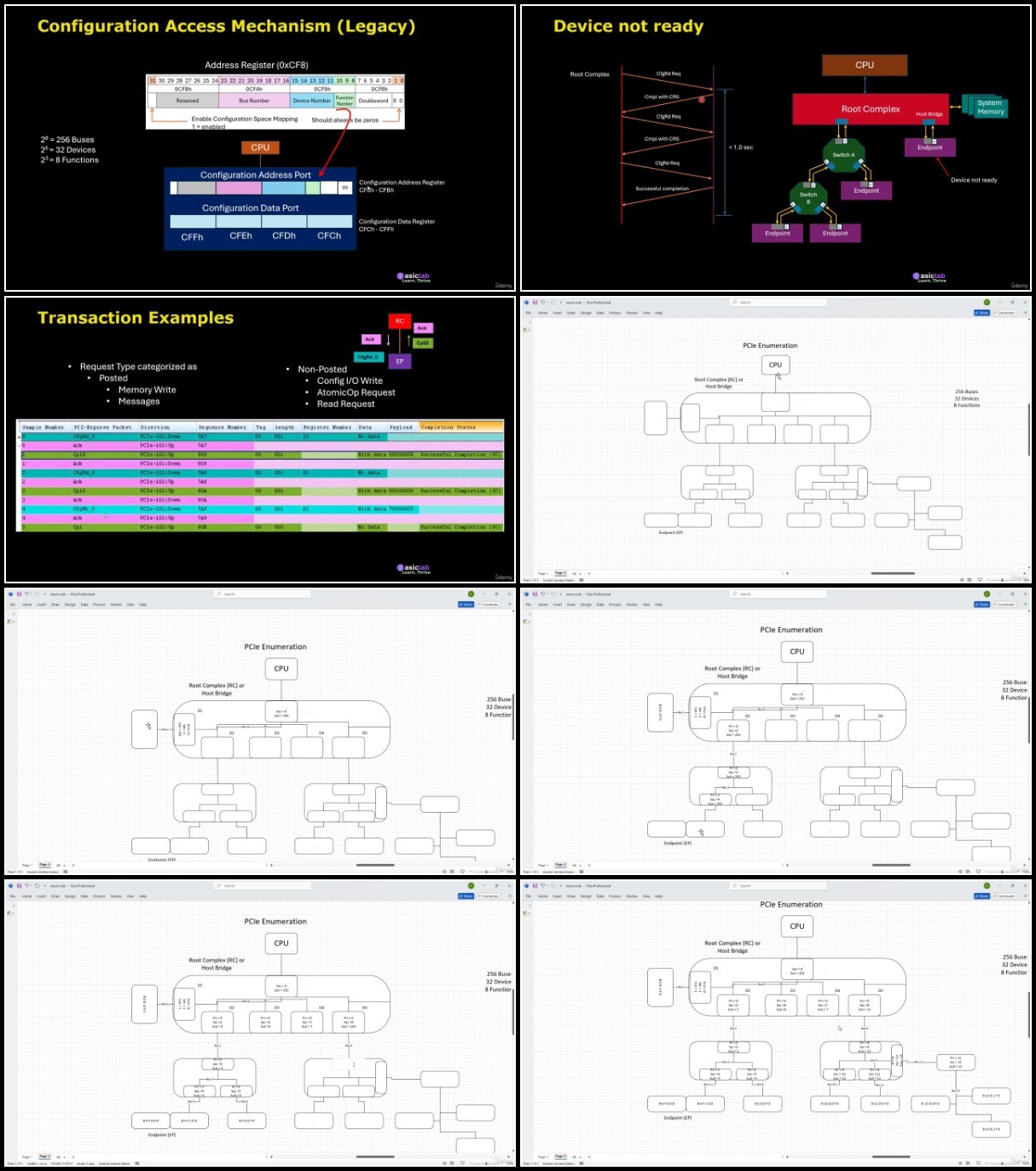
Lecture 10 Configuration Mechanism
Lecture 11 Enumeration
Lecture 12 Address space and Transaction routing
Section 3: Transaction Layer Gen 5.0
Lecture 13 PCIe Gen 5.0 TLP Structure
Lecture 14 Memory Request TLP
Lecture 15 Completion TLP
Lecture 16 Configuration TLP
Lecture 17 IO Request TLP
Lecture 18 Message TLP
Lecture 19 Flow Cotrol
Lecture 20 Transaction Ordering
Section 4: Transaction Layer Gen 6.0
Lecture 21 PCIE Gen 6.0 Flit Format
Lecture 22 Format Differences of Gen 5.0 vs Gen 6.0
Lecture 23 PCIE Gen 6.0 Flit Packing/Unpacking
Section 5: Data Link Layer Gen 5.0
Lecture 24 Gen 5.0/ NFM (Non Flit Mode) Operation
Section 6: Data Link Layer Gen 6.0
Lecture 25 Gen 6.0/FM (Flit Mode) Data Link Layer Operation
Lecture 26 Gen 6.0 Standard ACK/NAK Mechanism
Lecture 27 Grn 6.0 Selective ACK/NAK Mechanism
Section 7: Physical Layer
Lecture 28 Gen 5.0 Physical Layer Overview
Lecture 29 Physical Layer PIPE Interface
Lecture 30 Encoding/Eye Diagram Understanding
Lecture 31 Analog Front End details and eqaulization
Lecture 32 Clocking Architecture/Signal Integrity
Lecture 33 Ordered Set types
Lecture 34 Link Initialization and Training (LTSSM)
Lecture 35 Link Initialization and Training (LTSSM)
Lecture 36 Full LTSSM Overview
Lecture 37 Gen 6.0 Link Training
Lecture 38 LTSSM Debug methods
Lecture 39 Gen 7.0 Developments
Lecture 40 Resource Materials and Supplemental Documents
Beginners who wants to learn the PCIe protocol,Working professionals who want to enhance the knowledge,VLSI Design engineers who are designing the PCIe protocol,VLSI Verification engineers who are verifying different scenarios of PCIe protocol
TurboBit
https://filecrypt.cc/Container/1ED6536FFE.html
https://www.keeplinks.org/p27/67b447109340b
RapidGator
https://filecrypt.cc/Container/C6C1EFF33C.html
https://www.keeplinks.org/p27/67b447c428f66
AlfaFile
https://filecrypt.cc/Container/0799E8D185.html
https://www.keeplinks.org/p27/67b447db80ce1
FileFactory