

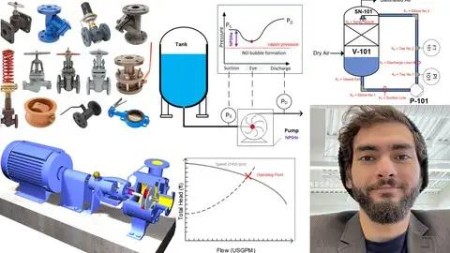
Pump Sizing & Modeling Piping Systems For Liquids
Published 5/2023
MP4 | Video: h264, 1280×720 | Audio: AAC, 44.1 KHz
Learn to size pumps and model piping systems & valves, calculate pressure drop through fittings, valves and components
What you’ll learn
Modeling of piping systems, components, fittings and valves for incompressible fluid.
Understand the Darcy equation, resistance coefficient (K), friction factor (f), flow coefficient (Cv), and orifice design.
Identify and understand the basic components of a pump and calculate pumps Hydraulic Horsepower , Brake Horsepower , Pump Efficiency, Motor Power & Motor Eff.
Understand pump curves for different impeller speeds (or diameters), pump efficiency curves, pump NPSHr curves and Power consumption curves.
Develop a roadmap for proper selection of pumps via excel macros and model resistance in series for a piping system.
Understand inherent valve curves, different types of control valves, valve authority, and size valves appropriately for a given system.
Requirements
While having prior engineering or field knowledge is desirable, it is not necessary for this course. The course is designed to explain all concepts in a clear and understandable language, allowing students to develop their knowledge from the basics.
No prior Excel macros knowledge required. Everything will be taught in this course.
Description
Overview
Section 1: Introduction
Lecture 1 About This Course
Lecture 2 Teaching Style
Lecture 3 Incompressible vs Compressible Fluids
Lecture 4 General Definitions: Viscosity (Dynamic vs Kinematic)
Lecture 5 General Definition: Reynolds Number (Laminar vs Turbulent Flow)
Lecture 6 General Definition: Flowrate
Section 2: Energy Balance
Lecture 7 Bernoulli’s Principle: Fluid Total Energy
Lecture 8 Bernoulli’s Principle: Energy Terms &Units
Lecture 11 Pipe Energy Balance Units
Lecture 12 Pump Energy Balance
Lecture 13 Example (Problem Statement)
Section 3: Friction Head Loss
Lecture 17 Darcy Equation, Resistance Coefficient
Lecture 18 Resistance Coefficient Examples
Lecture 19 Friction Factor
Lecture 21 Effect of Pipe Age on Friction Factor
Lecture 22 Flow Coefficient Cv
Lecture 23 Flow Coefficient Cv – viscosity and specific gravity correction
Lecture 24 Flow Coefficient Cv – capacity flowrate at different pressure drops
Lecture 25 Flow Coefficient Cv – Conversion to Resistance Coefficient K
Lecture 26 Orirfice Plate
Lecture 27 Orifice Plate Example
Section 4: Pumps
Lecture 28 Pump Intro
Lecture 30 Pump Power Losses
Lecture 31 Pump HHP, BHP,MP Efficiency
Lecture 32 Pump HHP, BHP,MP Efficiency Example
Lecture 33 Pump Curve
Lecture 34 Pump Performance Curves
Lecture 35 Pump Performance Curves Example
Lecture 36 Pump VFDs
Lecture 37 NPSH
Lecture 38 Affinity Laws
Section 5: System Modeling and Pump Sizing Roadmap
Lecture 39 Resistances in Series
Lecture 40 Pump Sizing Road Map
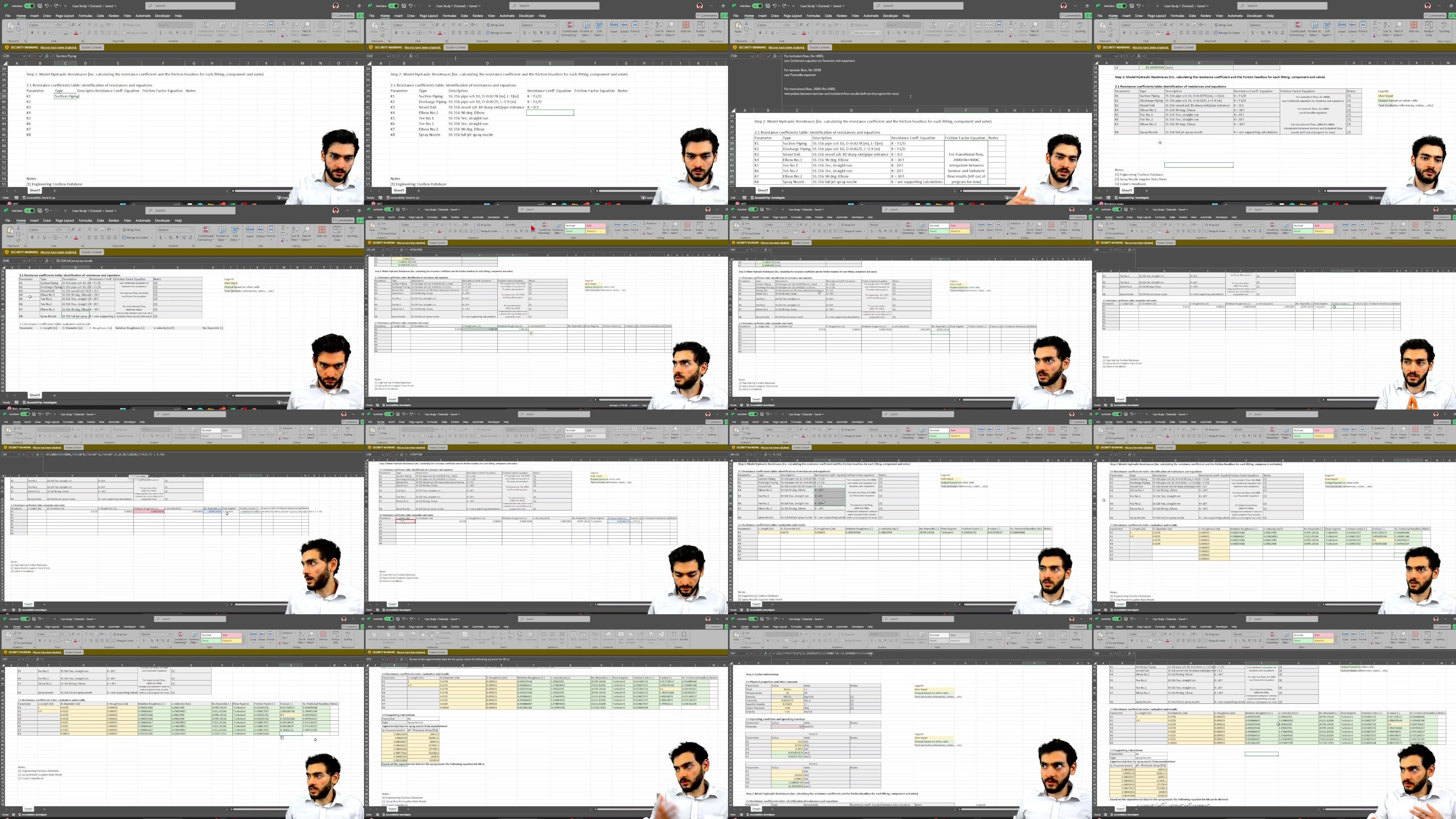
Section 6: Case Study I
Lecture 41 Case Study 1 – Problem Statement
Lecture 42 Case Study 1 – Solution Road Map
Section 7: Control Valves
Lecture 52 Valve Classification
Lecture 53 Control Valves
Lecture 54 Inherit Valve Curve
Lecture 55 Inherit Valve Curve Example
Lecture 56 Valve Authority
Engineers In-Training, Recent College graduates, Engineering Students,Chemical, Process, Petroleum Engineers,Piping, Plant Engineers,Mechanical Engineers,Maintenance Technicians,Plant Operators,Safety Engineers
DDownload
https://www.keeplinks.org/p27/68723780bf463
RapidGator
https://www.keeplinks.org/p27/68723983b52db
NitroFlare
https://www.keeplinks.org/p27/68723bf342322