

Last updated 12/2022
Duration: 46h 7m | .MP4 1280×720, 30 fps(r) | AAC, 44100 Hz, 2ch | 19.3 GB
What you’ll learn
A deep dive into Python’s memory management and optimizations
In-depth understanding and advanced usage of Python’s numerical data types (Booleans, Integers, Floats, Decimals, Fractions, Complex Numbers)
Advanced Boolean expressions and operators
Advanced usage of callables including functions, lambdas and closures
Create advanced decorators, including parametrized decorators, class decorators, and decorator classes
Advanced decorator applications such as memoization and single dispatch generic functions
Use and understand Python’s complex Module and Package system
Idiomatic Python and best practices
Understand Python’s compile-time and run-time and how this affects your code
Avoid common pitfalls
Requirements
You will need Python 3.6 or above, and a development environment of your choice (command line, PyCharm, Jupyter, etc.)
Description
Hello!
This is not a beginner course!
If you’ve been coding Python for a week or a couple of months, you probably should keep writing Python for a bit more before tackling this series.
I wonder how this works?
is there another, more pythonic, way, of doing this?
what’s a closure? is that the same as a lambda?
I know how to use a decorator someone else wrote, but how does it work? How do I write my own?
why do some boolean expressions not return a boolean value? How can I use that to my advantage?
how does the import mechanism in Python work, and why am I getting side effects?
and similar types of question.
then this course is for you.
To get the most out of this course, you should be prepared to pause the coding videos, and attempt to write code before I do! Sit back during the concept/theory videos, but lean in for the code videos!
Please make sure you review the pre-requisites for this course (below) – although I give a brief refresh of basic concepts at the beginning of the course, those are concepts you should already be very comfortable with as you being this course.
In this course series, I will give you a much more fundamental and deeper understanding of the Python language and the standard library.
Python is called a "batteries-included" language for good reason – there is a ton of functionality in base Python that remains to be explored and studied.
It’s about helping you explore Python and answer questions you are asking yourself as you develop more and more with the language.
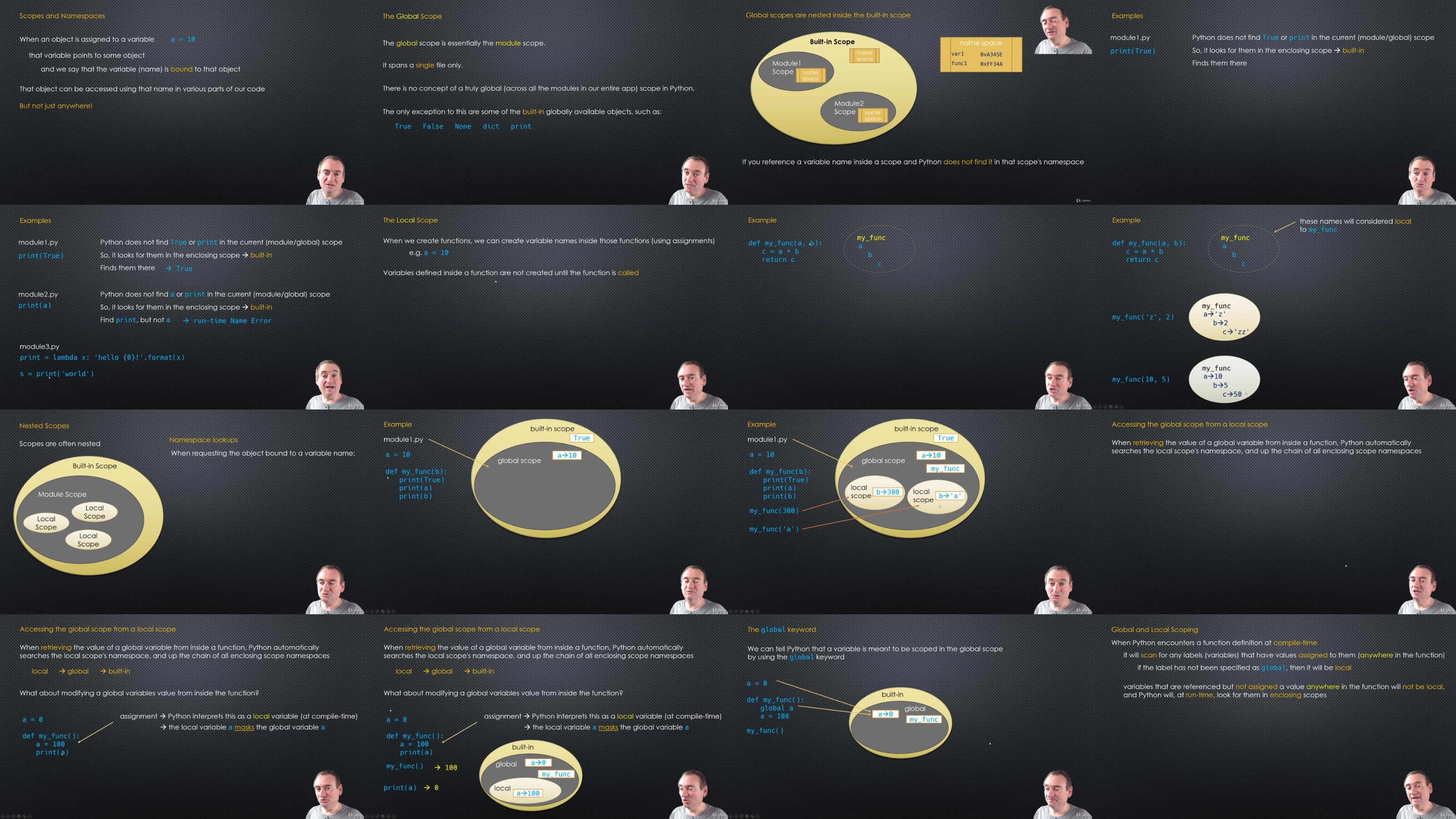
Namespaces and scopes
Python’s numeric types
Python boolean type – there’s more to a simple or statement than you might think!
Run-time vs compile-time and how that affects function defaults, decorators, importing modules, etc
Functions in general (including lambdas)
Functional programming techniques (such as map, reduce, filter, zip, etc)
Closures
Decorators
Imports, modules and packages
Tuples as data structures
Named tuples
Course Prerequisites
This is an intermediate to advanced Python course.
To have the full benefit of this course you should be comfortable with the basic Python language including:
for and while loops
if.else. statements
using simple lists , tuples , dictionaries and sets
defining functions (using the def statement)
writing simple classes using the class keyword and the __init__ method, writing instance methods, creating basic properties using @property decorators
importing modules from the standard library (e.g. import math)
You should also:
have Python 3.6 (or higher) installed on your system
be able to write and run Python programs using either:
the command line, or
a favorite IDE (such as PyCharm),
have Jupyter Notebooks installed (which I use throughout this course so as to provide you fully annotated Python code samples)
Who this course is for:
Anyone with a basic understanding of Python that wants to take it to the next level and get a really deep understanding of the Python language and its data structures.
Anyone preparing for an in-depth Python technical interview.
RapidGator
https://www.keeplinks.org/p27/68a9d413cbdec
NitroFlare
https://www.keeplinks.org/p27/68a9de2b94324
DDownload
https://www.keeplinks.org/p27/68a9e766b443e