

Last updated 12/2022
Duration: 21h 57m | .MP4 1280×720, 30 fps(r) | AAC, 44100 Hz, 2ch | 8.01 GB
Dictionaries, Sets, Related Data Structures, Serialization/Deserialization
What you’ll learn
Associative Arrays
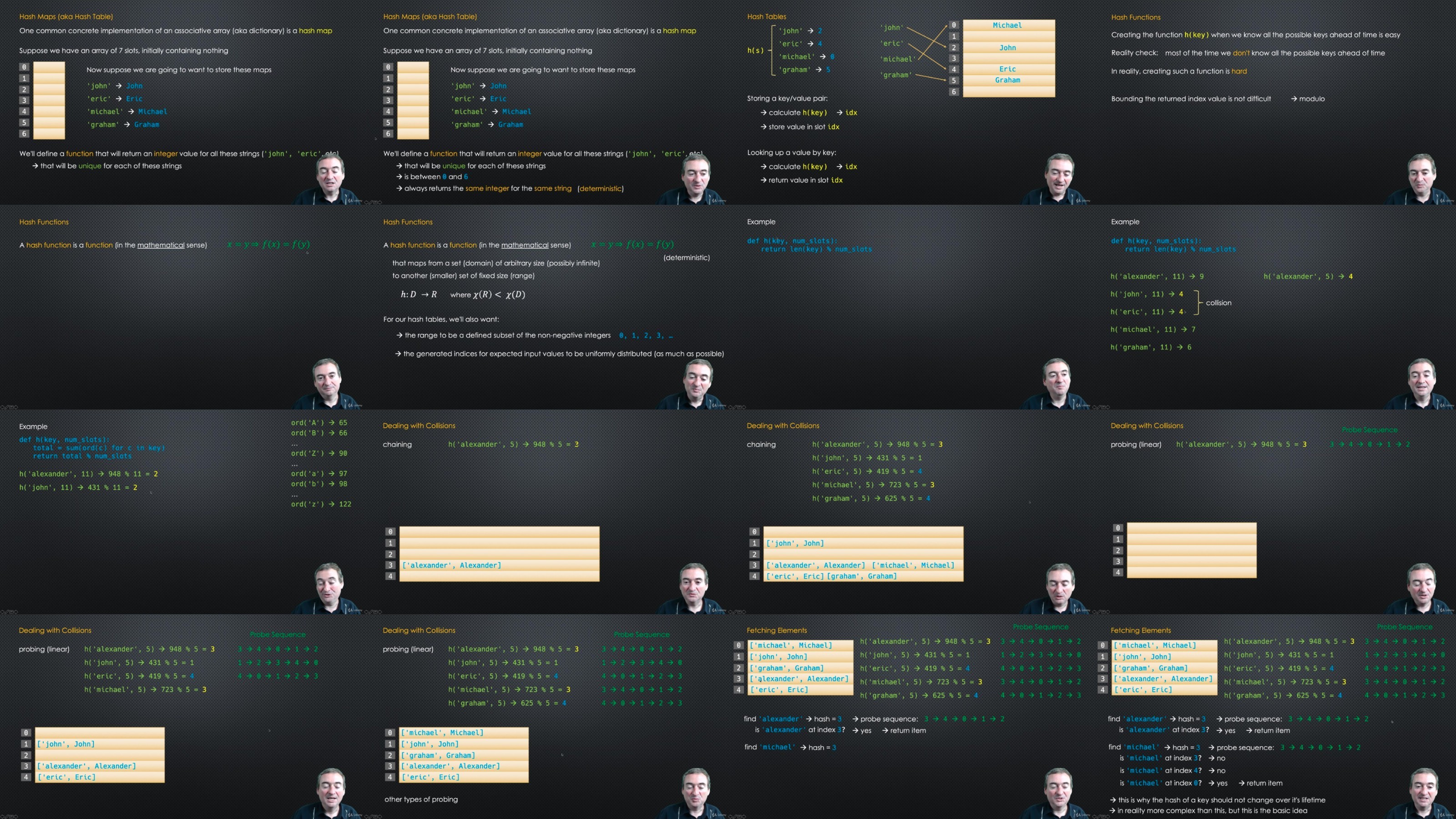
Hash Tables and Hash Functions
Python’s implementation of hash tables
Dictionaries and Sets
Defining hash functions for our custom classes and why that is useful
Creating customized dictionaries using the UserDict class
defaultdict
OrderedDict and Python3.6+ equivalences
Counter (multi-sets)
ChainMap
Serialization and Deserialization
JSON serialization/deserialization
Requirements
This is an advanced course, so a solid Python foundation is necessary
Jupyter Notebooks
functional programming (zip, map, sorted, any, all, etc)
lambdas, closures and decorators
built-in decorators such as @lru_cache, @singledispatch and @wraps
iterables, iterators, generators and context managers
Description
This course is an in-depth look at Python dictionaries.
Dictionaries are ubiquitous in Python. Classes are essentially dictionaries, modules are dictionaries, namespaces are dictionaries, sets are dictionaries and many more.
In this course we’ll take an in-depth look at:
associative arrays and how they can be implemented using hash maps
hash functions and how we can leverage them for our own custom classes
specialized dictionary structures such as OrderedDict and how it relates to the built-in Python3.6+ dict
Python’s implementation of multi-sets, the Counter class
the ChainMap class
how to create custom dictionaries by inheriting from the UserDict class
how to serialize and deserialize dictionaries to JSON
the use of schemas in custom JSON deserialization
a brief introduction to some useful libraries such as JSONSchema, PyYaml and Serpy
***** Prerequisites *****
Please note that this is a relatively advanced Python course, and a strong knowledge of some topics in Python is required.
Beyond the basics of Python (loops, conditional statements, exception handling, built-in data types, creating classes, etc), you should also have an in-depth understanding of the following topics:
functions and functional programming (recursion, *args, **kwargs, zip, map, sorted, any, all, etc)
lambdas, closures and decorators (including standard decorators such as @singledispatch, @wraps, etc)
iterables, iterators, generators and context managers
named tuples
Finally, most of the code in this course is illustrated using the freely available Jupyter Notebooks, so you will need that as well.
Who this course is for:
Python developers who want a deeper understanding of Python dictionaries and related topics
RapidGator
https://www.keeplinks.org/p27/68ac4d67118ff
NitroFlare
https://www.keeplinks.org/p27/68ac5025647ac
DDownload
https://www.keeplinks.org/p27/68ac521f0323b