


Python Oop: Object Oriented Programming From Beginner To Pro
Published 12/2024
MP4 | Video: h264, 1920×1080 | Audio: AAC, 44.1 KHz
Everything you need to develop great object oriented software. Classes, objects, polymorphism, SOLID, Design Patterns.
What you’ll learn
Go from complete OOP beginner to being confident and ready to get a job working on OOP software
Learn the basics of OOP: creating classes, objects, attributes, methods, access modifiers, abstract classes, getters & setters, properties, static attributes.
Understand crucial OOP concepts with examples: encapsulation, abstraction, inheritance, polymorphism, coupling, composition, dependency injection
The five SOLID principles show you how to assign responsibilities to classes and manage relationships between them
The "Gang of Four" Design Patterns: proven solutions to recurring problems in software design, so you don’t have to reinvent the wheel
Unified Modelling Language (UML) for visually modelling classes and the relationships between them in a standardised way
Requirements
You need no knowledge of object-oriented programming to take this course. I will teach you from the very basics to an advanced level.
Description
Overview
Section 1: Introduction
Lecture 1 Welcome to Python OOP! Who is this course for?
Lecture 2 What you will learn
Lecture 3 About me
Lecture 4 Setup and Github
Lecture 5 Creating classes and objects
Lecture 6 Recap: creating classes and objects
Lecture 7 Combining objects
Lecture 8 Recap: classes, objects, attributes, methods and self
Lecture 9 Example: a Person class
Lecture 10 Accessing and modifying object data
Lecture 11 Access modifiers: protected attributes
Lecture 12 When should you make an attribute protected?
Lecture 14 When to use protected vs private attributes
Lecture 15 Creating getter and setter methods
Lecture 16 Why do we create getters and setters?
Lecture 17 Properties: creating a getter property. Properties vs getters and setters
Lecture 18 Properties: creating a setter property
Lecture 19 Static attributes
Lecture 20 Static attributes vs instance attributes
Lecture 21 Static methods
Lecture 22 Static methods: when to use them?
Lecture 23 Protected and private methods
Lecture 24 Introduction
Lecture 25 Encapsulation
Lecture 26 Encapsulation: why is it important?
Lecture 27 Abstraction
Lecture 28 Inheritance
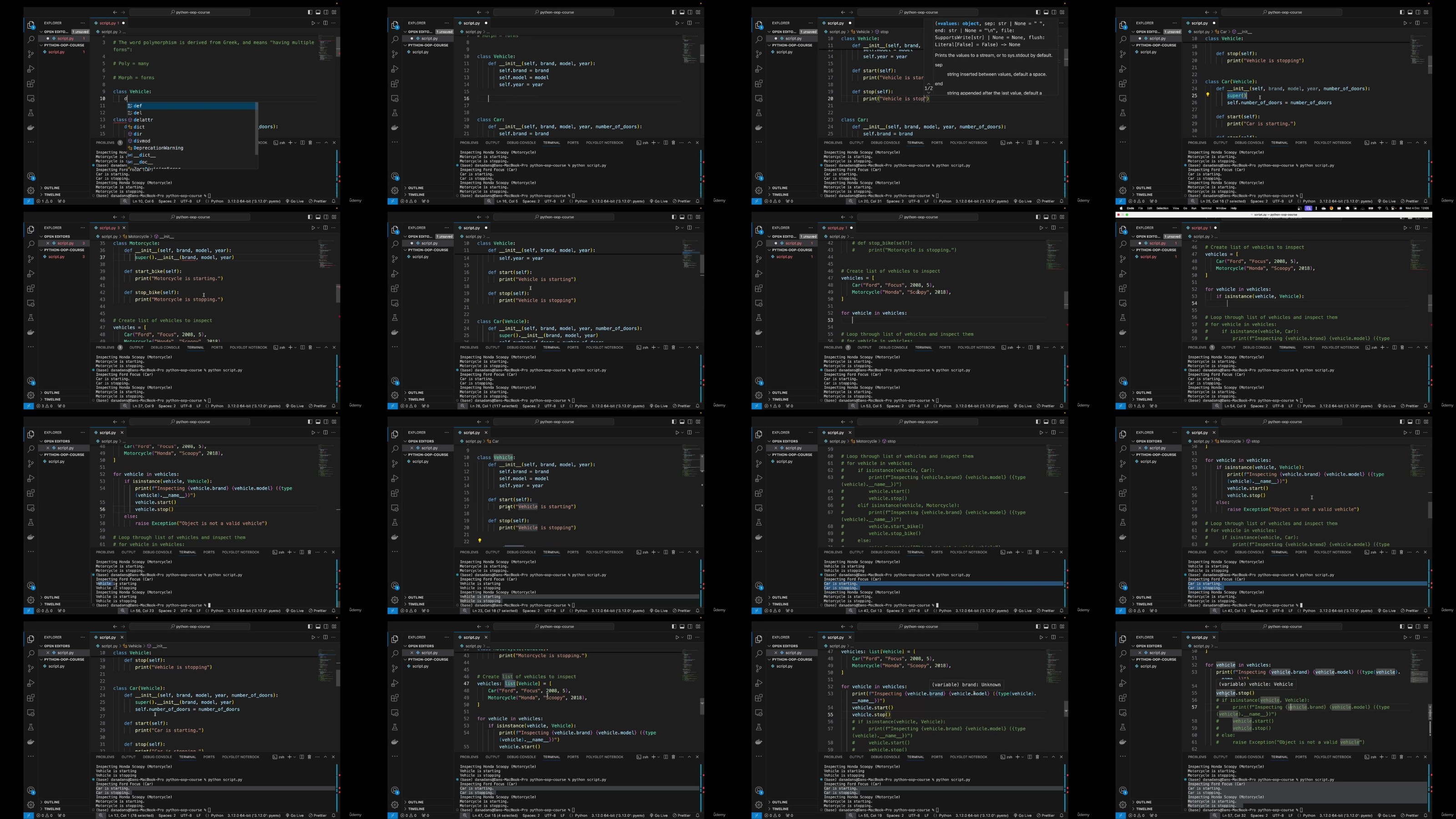
Lecture 29 Polymorphism: intro and naive solution
Lecture 30 Polymorphism: refactored solution
Lecture 31 Coupling: intro and naive solution
Lecture 32 Coupling: refactored solution
Lecture 33 Abstract classes and abstract methods
Lecture 34 Composition
Lecture 35 When to use composition vs inheritance
Lecture 36 The Fragile Base Class Problem
Lecture 37 A super fast crash course in UML
Lecture 38 Introduction
Lecture 39 Single Responsibility Principle (SRP): intro and naive solution
Lecture 40 SRP: refactored solution
Lecture 41 Caveat: using composition in service classes
Lecture 42 Caveat II: using method parameters in service classes
Lecture 43 Open/closed principle (OCP): intro and naive solution
Lecture 44 OCP: refactored solution
Lecture 45 Liskov Substitution Principle (LSP): intro and naive solution
Lecture 46 LSP: refactored solution
Lecture 47 LSP: demonstrating why this solution satisfies LSP
Lecture 48 Interface Segregation Principle (ISP): intro and naive solution
Lecture 49 ISP: refactored solution
Lecture 50 Dependency Inversion Principle (DIP): intro and naive solution
Lecture 51 DIP: UML + what are "high-level" and "low-level" modules?
Lecture 52 DIP: refactored solution with dependency injection
Lecture 53 DIP: UML and discussion
Lecture 54 The benefits of dependency injection
Lecture 55 What are design patterns? Why do we need them?
Lecture 56 The three groups of design patterns: Behavioural, Structural and Creational
Lecture 57 Behavioural Design Patterns: intro
Lecture 58 State Pattern: intro
Lecture 59 State Pattern: naive solution
Lecture 60 State Pattern: UML and discussion
Lecture 61 State Pattern: refactored solution
Lecture 62 State Pattern: when to use it (and not use it)
Lecture 63 Observer Pattern: intro
Lecture 64 Observer Pattern: naive solution
Lecture 65 Observer Pattern: UML and discussion
Lecture 66 Observer Pattern: refactored solution
Lecture 67 Observer Pattern: push vs pull communication
Lecture 68 Structural Design Patterns: intro
Lecture 69 Facade Pattern: intro
Lecture 70 Facade Pattern: naive solution
Lecture 71 Facade Pattern: UML and discussion
Lecture 72 Facade Pattern: refactored solution
Lecture 73 Adapter Pattern: intro
Lecture 74 Adapter Pattern: example
Lecture 75 Adapter Pattern: introducing a problem
Lecture 76 Adapter Pattern: UML and discussion
Lecture 77 Adapter Pattern: refactored solution
Lecture 78 Adapter Pattern: should we use inheritance or composition?
Lecture 79 Creational Design Patterns: intro
Lecture 80 Prototype Pattern: intro
Lecture 81 Prototype Pattern: naive solution
Lecture 82 Prototype Pattern: UML and discussion
Lecture 83 Prototype Pattern: refactored solution
Lecture 84 Abstract Factory Pattern: intro
Lecture 85 Abstract Factory Pattern: naive solution
Lecture 86 Abstract Factory Pattern: UML and discussion
Lecture 87 Abstract Factory Pattern: refactored solution
Lecture 88 Abstract Factory Pattern: discussing the refactored solution
Section 7: Conclusion
Lecture 89 Congratulations! Where do I go from here?
Any level of Python developer that wants to fully understand OOP in Python and feel confident working on real OOP software.
RapidGator
https://www.keeplinks.org/p27/67c721414bc5d
NitroFlare
AlfaFile
https://www.keeplinks.org/p27/67c72246c0b18
FileFactory