

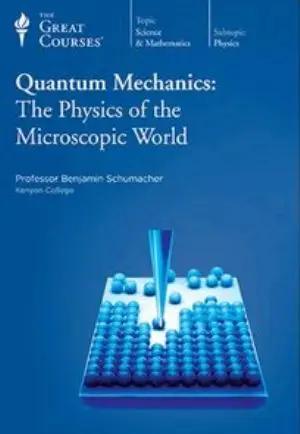
Quantum Mechanics: The Physics of the Microscopic World
Genre: Physics
In the following decades, a series of great physicists built on Planck’s discovery, including Albert Einstein, Niels Bohr, Louis de Broglie, Werner Heisenberg, Erwin Schrödinger, Richard Feynman, and many others, developing quantum mechanics into the most successful physical theory ever devised-the general framework that underlies our understanding of nature at its most fundamental level.
Quantum mechanics gives us a picture of the world that is so radically counterintuitive that it has changed our perspective on reality itself, raising profound questions about concepts such as cause and effect, measurement, and information. Despite its seemingly mysterious nature, quantum mechanics has a broad range of applications in fields such as chemistry, computer science, and cryptography. It also plays an important role in the development and innovation of some of today’s most amazing-and important-technologies, including lasers, transistors, microscopes, semiconductors, and computer chips.
Quantum Mechanics: The Physics of the Microscopic World gives you the logical tools to grasp the paradoxes and astonishing insights of quantum mechanics in 24 half-hour lectures designed specifically for nonscientists and taught by award-winning Professor Benjamin Schumacher of Kenyon College.
No comparable presentation of this subject is so deep, so challenging, and yet accessible. Quantum Mechanics is generously illustrated with diagrams, demonstrations, and experiments and is taught by a professor who is both a riveting lecturer and a pioneer in the field, for Professor Schumacher is an innovator in the exciting new discipline of quantum information.
Think Like a Physicist
Working on the principle that any discovery made by the human mind can be explained in its essentials to the curious learner, Professor Schumacher teaches you how to reason like a physicist in working out the features of the quantum world. After taking this course, the following apparently inexplicable phenomena will make sense to you as logical outcomes of quantum processes:
That quantum mechanics takes us to a bedrock level of reality where objects are utterly simple, identical in every respect
That even in the complete vacuum of empty space, there is still a vast amount of energy bubbling into and out of existence
Regarding the last phenomenon, you could say that quantum mechanics not only changes our view of everything, it also changes our view of "nothing!"
Quantum Puzzles
Quantum mechanics has even entered popular language with expressions such as "quantum leap," which is often used inaccurately to mean a radical transformation. In quantum mechanics, a quantum leap is the minimum change in the energy level of an electron, related to the discrete units of light energy discovered by Max Planck.
Another familiar expression is the "uncertainty principle," an idea formulated by Werner Heisenberg in the 1920s. Again, popular usage can be misleading, since one often hears the term used to mean the unavoidable disturbance caused by making an observation. But in quantum mechanics the concept refers to an elementary feature of the microworld-that certain properties have no well-defined values at all.
Little wonder that quantum mechanics is one of the few fields in which philosophical speculation goes hand in hand with scientific breakthroughs. Consider these quantum puzzles that have striking philosophical implications:
Schrödinger’s cat: Erwin Schrödinger noted that the standard Copenhagen interpretation of quantum mechanics makes it possible for a cat to be considered simultaneously dead and alive when exposed to a potentially lethal quantum situation.
Clear, Enlightening, and Thorough
Quantum Mechanics begins by exploring the origin of quantum mechanics and its golden age of discoveries in the early 20th century before taking you deeply into the key concepts and methods of the discipline. Then Professor Schumacher rounds out the course with a discussion of selected topics, including the potentially revolutionary applications of quantum cryptography and quantum computing. Throughout, he adheres to the following very helpful ground rules, tailored to give those without any previous preparation in math and physics a clear, enlightening, and thorough introduction to quantum mechanics:
He presents the real theory of quantum mechanics, not a superficial popularization.
He simplifies the subject to highlight fundamental principles.
He uses thought experiments, or hypothetical examples, as a tool for probing quantum phenomena.
One thought experiment that Professor Schumacher returns to involves a Mach-Zehnder interferometer, a simple arrangement of mirrors and detectors that illustrates basic properties and paradoxes of quantum mechanics. By considering the different paths that a photon can take through the interferometer, you discover such key principles as constructive and destructive interference, Max Born’s probabilistic explanation of quantum phenomena, and Niels Bohr’s concept of complementarity that led to the Copenhagen interpretation-the view of quantum mechanics since the 1920s.
Lectures:
1. The Quantum Enigma
2. The View from 1900
3. Two Revolutionaries-Planck and Einstein
5. Standing Waves and Stable Atoms
6. Uncertainty
7. Complementarity and the Great Debate
8. Paradoxes of Interference
9. States, Amplitudes, and Probabilities
11. Quantum Twins
13. Antisymmetric and Antisocial
14. The Most Important Minus Sign in the World
15. Entanglement
16. Bell and Beyond
17. All the Myriad Ways
18. Much Ado about Nothing
19. Quantum Cloning
20. Quantum Cryptography
21. Bits, Qubits, and Ebits
23. Many Worlds or One?
24. The Great Smoky Dragon
screenshot
Do not forget to check my blog! Updated regularly!
No mirrors pls!
