

Real-Time Ai Animal Identification With Deep Learning & Cv
Published 5/2025
MP4 | Video: h264, 1920×1080 | Audio: AAC, 44.1 KHz
Tracking the Wild: Real-Time Animal Identification Using Deep Learning with Python & Computer Vision
What you’ll learn
Learn real-time animal detection and ID basics, and their role in wildlife monitoring, conservation, and ecological research.
Set up Python with TensorFlow/Keras for deep learning and OpenCV for image preprocessing to enable robust, real-time animal classification.
Explore the EfficientNetB0 model, optimized for accurate animal classification across 90 species, and its application in real-time video feeds.
Learn data preprocessing techniques, including image normalization, resizing, and augmentation, to improve model performance and generalization.
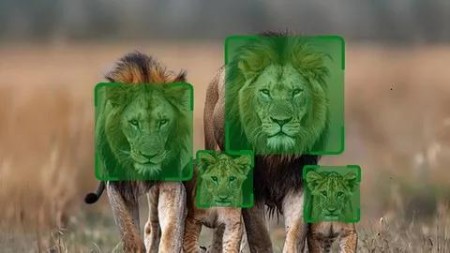
Implement real-time visualization of identified animals by annotating video frames with bounding boxes, species labels, and confidence scores.
Utilize Flask as a backend framework to serve detection results and integrate with an interactive web-based dashboard for monitoring.
Enable global streaming of real-time detection using Ngrok, allowing remote access to the live video feed from any location.
Implement MQTT for efficient transmission of detected animal data, facilitating seamless communication with IoT-based monitoring systems.
Use the system for wildlife conservation, anti-poaching, and research focused on habitat monitoring and biodiversity tracking.
Requirements
Basic understanding of Python programming (helpful but not mandatory).
A laptop or desktop computer with internet access [Windows OS with Minimum 4GB of RAM).
No prior knowledge of AI or Machine Learning is required-this course is beginner-friendly.
Enthusiasm to learn and build practical projects using AI and IoT tools.
DescriptionOverview
Section 1: Introduction to Animal Detection System
Lecture 1 Course Introduction and Features
Section 2: Environment Setup for Python Development
Lecture 2 Installing Python
Lecture 3 VS Code Setup for Python Development
Section 3: Animal Detection System Project Overview
Lecture 4 Animal Detection System Project Overview
Section 4: Setting Up Google Colab and Mounting Google Drive
Lecture 5 Setting Up Google Colab and Mounting Google Drive
Section 5: Dataset Download and Exploration
Lecture 6 Dataset Download and Exploration
Section 6: Dataset Preprocessing and Augmentation
Lecture 7 Dataset Preprocessing and Augmentation
Section 7: Splitting the Dataset for Training, Validation, and Testing
Lecture 8 Splitting the Dataset for Training, Validation, and Testing
Section 8: Visualizing the Animal Dataset and Augmented Data
Lecture 9 Visualizing the Animal Dataset and Augmented Data
Section 9: EfficientNetB0 Model Implementation
Lecture 10 EfficientNetB0 Model Implementation
Section 10: Training the EfficientNetB0 Model and Monitoring Progress
Lecture 11 Training the EfficientNetB0 Model and Monitoring Progress
Section 11: Model Inference using Flask and Ngrok
Lecture 12 Model Inference using Flask and Ngrok
Section 12: Code Execution
Lecture 13 Code Execution
Section 13: Wrapping Up
Lecture 14 Course Wrap-Up

DDownload
https://www.keeplinks.org/p27/685c51ac7c3bc
https://ddownload.com/96tv4afeafps/yxusj.Real-Time.AI.Animal.Identification.with.Deep.Learning..CV.rar
RapidGator
https://www.keeplinks.org/p27/685c582dde4fd
https://rapidgator.net/file/d814540754d2b4c1b618ca6bb8f45adc/yxusj.Real-Time.AI.Animal.Identification.with.Deep.Learning..CV.rar
NitroFlare
https://www.keeplinks.org/p27/685c585b6d5de
https://nitroflare.com/view/0BFEFA3EC07AB94/yxusj.Real-Time.AI.Animal.Identification.with.Deep.Learning..CV.rar