

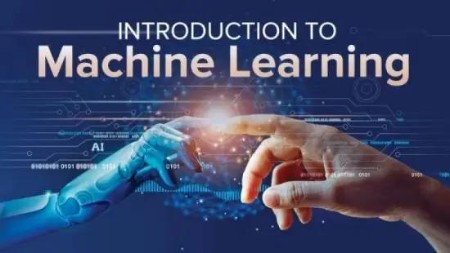
TTC – Introduction to Machine Learning
Duration: 12h 07m | .MP4 1280×720, 30 fps(r) | AAC, 48000 Hz, 2ch | 10.1 GB
Introduction to Machine Learning demystifies this revolutionary discipline in 25 try-it-yourself lessons taught by award-winning educator and researcher Michael L. Littman, the Royce Family Professor of Teaching Excellence in Computer Science at Brown University. Dr. Littman guides you through the history, concepts, and techniques of machine learning, using the popular computer language Python to give you hands-on experience with the most widely used programs and specialized libraries .
Dig into the Details
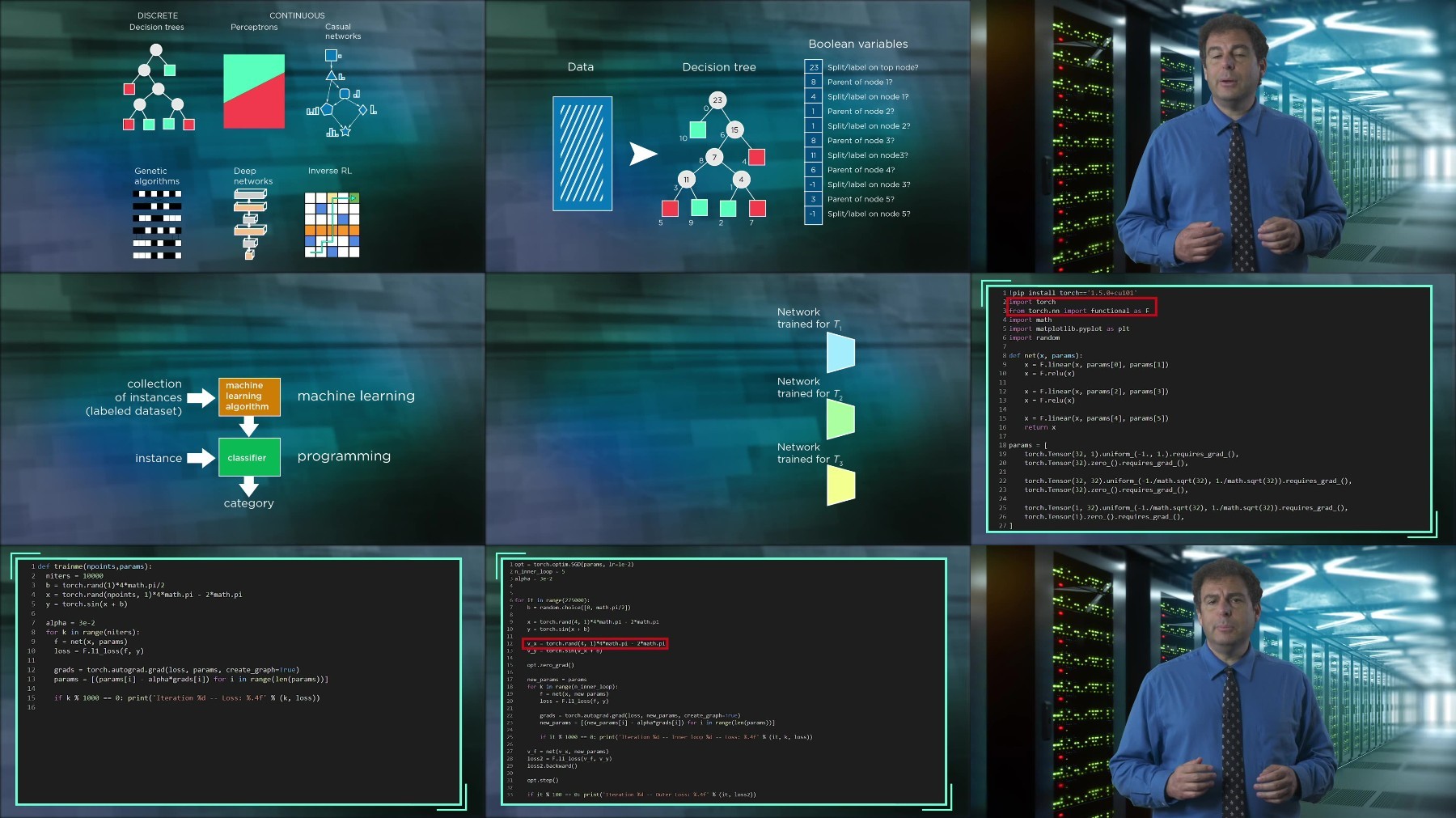
In Introduction to Machine Learning, you investigate three major types of representational spaces, focusing on the types of problems they excel at solving.
Bayesian Networks: In contrast to decision trees, which rely on a sequence of deductions, Bayesian networks involve inferences from probability. They are well-suited to cases where you need to work backwards from the data to their likely causes. A prominent example is software that identifies probable spam messages.
You delve into the mechanics of each of these strategies as well as their pitfalls, especially overfitting, which is when a rule works too well. Overfitting may sound like a good thing, but it is a sign that the rule is tailored too closely to the original data and may not work on new data that requires treatment with a general rule. Professor Littman explains how to steer clear of this hazard and deal with other problems, such as hidden biases, sampling flaws, and false positives.
Embark on Your Own Coding Adventures
Another way to classify machine learning programs is the degree of human input involved. Does the programmer specify a desired outcome or leave it to the computer-or is the approach something in between? These different strategies are:
Supervised Learning: Here, the desired answer is supplied by the programmer as a training dataset that acts as a teacher to guide the learning process. Recommender systems where the user rates a product work like this. So do a host of other machine-learning programs where examples are labeled with their relevant attribute.
Unsupervised Learning: This approach is like having no teacher at all. There is no right answer, just training data to be compared to test data in a search for similarity. News story recommender systems typically work this way, since people rarely rate the news.
Reinforcement Learning: This hybrid strategy is Dr. Littman’s favorite style of machine learning. Think of it as like having access to a critic. You are not being told what to do; you are simply getting feedback on how well you did it. The many examples of reinforcement learning in this course include an entire lesson on game-playing programs.
Throughout this extraordinary course, you dig deeply into the uses of machine learning for cutting-edge problems in research, education, business, entertainment, and daily life. You also consider the social implications of machine learning, which are likely to loom ever larger as its influence grows. Dr. Littman stresses that it’s up to each of us to ensure that this technology is applied in ways that benefit us all.
Therefore, it’s up to us to boost our machine-learning literacy. Many people regard the subject as a black box, where inscrutable things happen that lead to today’s technological wonders. Fortunately, Professor Littman has a gift for making opaque processes not only clear, but captivating. Introduction to Machine Learning will open your eyes to this thrilling field and, better yet, pave the way for your own coding adventures in machine learning.
More Info
TurboBit
https://www.keeplinks.org/p27/67cb556a25444
RapidGator
https://www.keeplinks.org/p27/67cb57d463b2a
AlfaFile
https://www.keeplinks.org/p27/67cb58149e9c6
FileFactory