

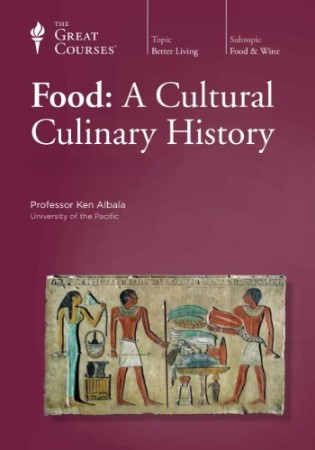
TTC Video – Food: A Cultural Culinary History
Lecturer: Ken Albala, Ph.D. | Course No. 9180
In fact, civilization itself began in the quest for food. Humanity’s transition to agriculture was not only the greatest social revolution in history, but it directly produced the structures and institutions we call "civilization."
In our own times, more people worldwide now recognize the McDonald’s "golden arches" than the Christian cross. Beyond feeding our bodies, food choices and ideologies express social distinctions, as well as our values, concerns, and aspirations. For all of these reasons, food offers a deeply insightful lens on human history, shedding new light on the evolution of social and political systems, on cultural interactions, economic empires, human migrations, and more. Through food culture, we see how primary biological needs have shaped all human lives through the ages. The history of food is the history of human life at its most elemental, its most intimate, its most essential. It’s also a story of ingenuity, creativity, and remarkable human behavior to rival any other aspect of culture.
In Food: A Cultural Culinary History, award-winning Professor Ken Albala of the University of the Pacific puts this extraordinary subject on the table, taking you on an enthralling journey into the human relationship to food. With this innovative course, you’ll travel the world discovering fascinating food lore and culture of all regions and eras-as an eye-opening lesson in history as well as a unique window on what we eat today.
Food as a Driver of Human History
As context for exploring humanity’s remarkable food cultures, you observe the integral role of food in the unfolding of civilization. From prehistory to our own era, your study includes these seminal subjects:
- The revolutions of agriculture: Learn how agriculture arose in the prehistoric world and how it spurred the development of urban organization, political systems, social classes, militaries, and trade.
- Coffee, tea, sugar, and slaves: Discover how the trade in a group of superfluous luxury items in the era of European colonialism altered the focus of the global economy.
- Big business and food imperialism: Observe the vast industrialization of food production in the late 19th and 20th centuries; its economic and human consequences; and the ideologies, movements, and practices that arose to oppose it.
A Global Richness of Culinary Cultures
- Status and ritual in ancient Rome: Learn how Roman food reflected social rank, wealth, and sophistication, and investigate the dining habits of the upwardly mobile as well as the gastronomic eccentricities of the emperor Heliogabalus.
- Aztec food culture: In this unique New World tradition, discover the Aztec way of life-the indigenous foodstuffs, eating rituals, and "signature" foods, from chilies to chocolate.
- Sumptuous dining in the Renaissance: Study the sophistication and complexity of Renaissance-era food culture in the writings of Platina, Ficino, and Messisbugo, and witness the extravagance of banquets at the court of Ferrara.
- "Scientific" cooking in the 21st century: In our own diverse era, encounter the phenomenon of "molecular gastronomy"-technology-enhanced food creations designed to titillate and amaze the palate.
A Colorful and Diverse Learning Experience
And, throughout the series, the lectures pulsate with surprising and intriguing details of the human adventure with food:
- Dinner knives with rounded tips were developed to reduce the threat of violence at the table.
- The world’s first restaurant-based food culture was Edo-era Japan.

DDownload
https://www.keeplinks.org/p27/699e79bd0415c
RapidGator
https://www.keeplinks.org/p27/699e7e04b1575
NitroFlare
https://www.keeplinks.org/p27/699e848acff1d
TakeFile
https://www.keeplinks.org/p27/699e8d2803437