

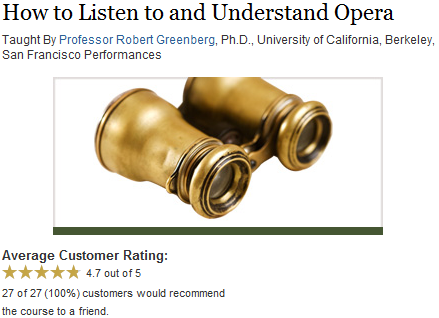
TTC VIDEO – How to Listen to and Understand Opera (2011)
DVD-Rip | AVI | XviD MPEG4 @ 1 Mbit/s | 640×480 | MP3 Stereo @ 256 Kbit/s 48 KHz | 24 Hours | 9.35 GB
With Professor Robert Greenberg to show you how, you can learn to understand, appreciate-even to love-opera in just 24 hours of lectures that are a pleasure to hear.
"Dr. Greenberg performed a miracle-he made me enjoy opera."
"Now I understand why I already loved opera."
The history of opera is traced from its beginning in the early 17th century to around 1924. The lectures examine landmark operas; musical, cultural, and social developments that influenced opera’s growth; and the influence of national languages and cultures on opera.The first eight lectures are foundational. You examine the origins of opera and the adaptations of other musical forms that allowed opera to achieve its full effects, first accomplished in Monteverdi’s Orfeo of 1607.
But Professor Greenberg does not hide the result while waiting on history to get us there. The course opens with one of the most powerful moments in opera-the dramatically loaded aria "Nessun dorma" ("No one shall sleep") from Giacomo Puccini’s Turandot.
In Turandot, you are exposed to opera’s unique incorporation of soliloquy, dialogue, scenery, action, and continuous music into an incredibly expressive and exciting whole.
This famous aria shows us the power of the composer-the power of creating music that goes beyond the words of the libretto to express thoughts and feelings that cannot be expressed in words.The study continues with a discussion of how music reveals character and the unconscious state. You are introduced to operatic archetypes such as Figaro and Carmen.
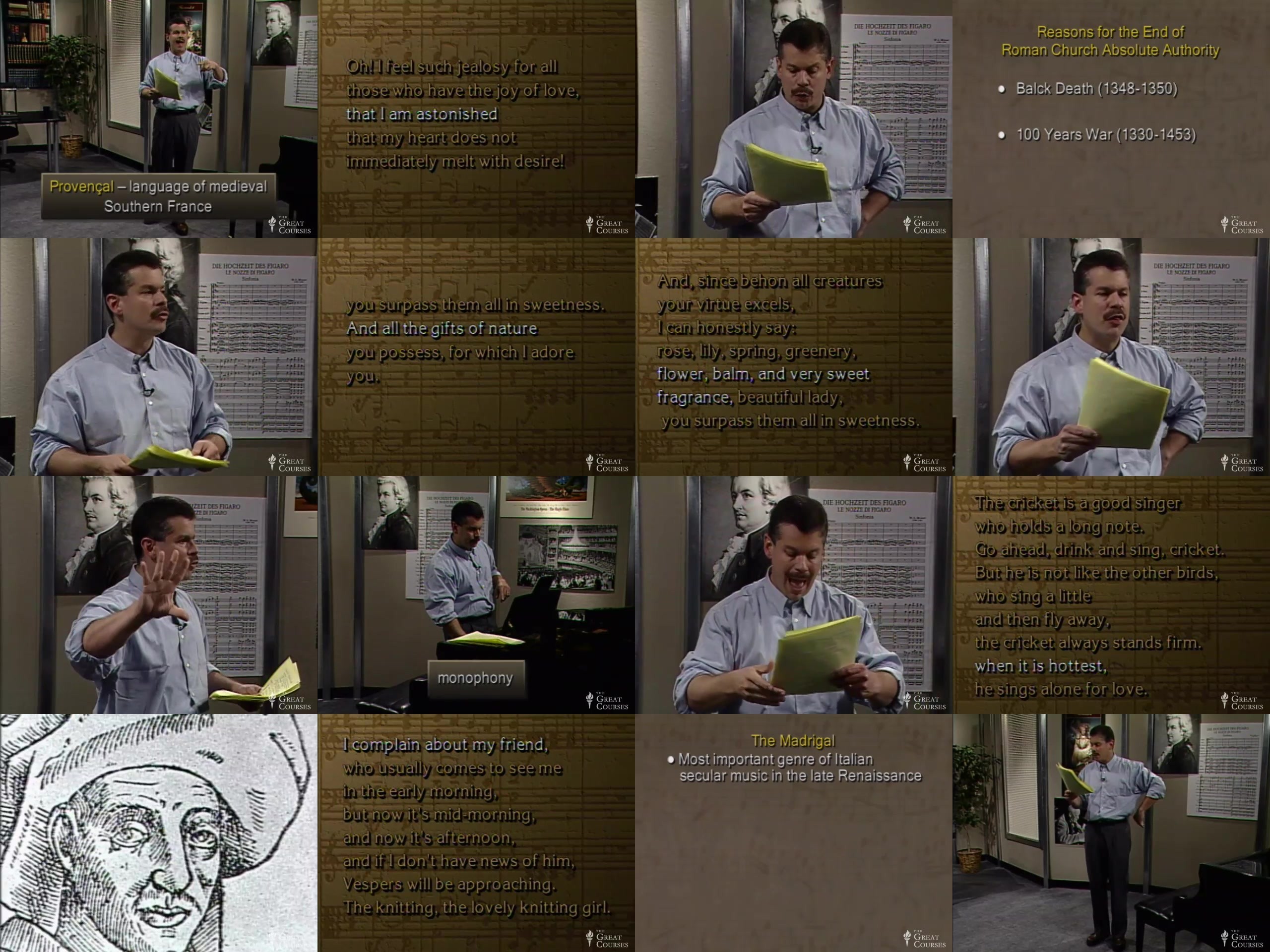
You examine how the rediscovery of ancient Greek and Roman culture contributed to the riches of the Renaissance. You see the evolution of the madrigal, a form that was ultimately rejected in favor of a more expressive vocal medium: early opera.
Recitative, the essence of Monteverdi’s style, made music subservient to words, but because of its forward-driving nature, recitative cannot express personal reflection.
You learn how the invention of the aria gave opera composers a powerful tool to stop the dramatic action for characters’ moments of self-reflection.
Dr. Greenberg reveals how highly pressurized the business of opera was in the 18th century. Rossini once remarked, "In my time, all the impresarios of Italy were bald by 30." You are introduced to Rossini’s The Barber of Seville of 1816 as the quintessential bel canto opera.Verdi’s Otello is discussed as one of the greatest operas of all time.
You examine Russian opera and nationalism. The late development of Russian opera is outlined from Mikhail Glinka’s Ruslan and Lyudmila to Modest Mussorgsky’s Boris Godunov. You see how the Russian language shaped the vocal style of Russian opera.
The course concludes with an overview of opera verismo, a 19th- and 20th-century genre that favors depictions of the darker side of the human condition; a transcendent example of it is in the pivotal second act of Giacomo Puccini’s Tosca.
Course Lecture Titles
32 Lectures
45 minutes / lecture01. Introduction and Words and Music, I
02. Introduction and Words and Music, II
03. A Brief History of Vocal Expression in Music, I
04. A Brief History of Vocal Expression in Music, II
05. Invention of Opera and Monteverdi’s Orfeo, I
06. Invention of Opera and Monteverdi’s Orfeo, II
07. Invention of Opera and Monteverdi’s Orfeo, III
08. Invention of Opera and Monteverdi’s Orfeo, IV
17. The Bel Canto Style and Rossini’s The Barber of Seville, I
18. The Bel Canto Style and Rossini’s The Barber of Seville, II
19. Verdi and Otello, I
20. Verdi and Otello, II
21. Verdi and Otello, III
22. Verdi and Otello, IV
26. Richard Wagner and Tristan und Isolde, I
27. Richard Wagner and Tristan und Isolde, II
29. Russian Opera, I
30. Russian Opera, II
31. Verismo, Puccini, and Tosca, I
32. Verismo, Puccini, and Tosca, II
DDownload
https://www.keeplinks.org/p27/68979b8803b8d
RapidGator
https://www.keeplinks.org/p27/68979c9283bf9
NitroFlare
https://www.keeplinks.org/p27/68979fa833e6e