

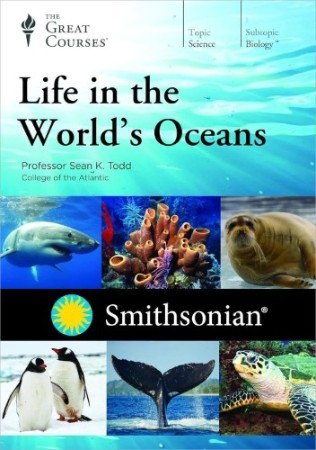
TTC Video – Life in the World’s Oceans
Lecturer: Sean K. Todd, Ph.D. Professor, College of the Atlantic | Course No. 1725
Phytoplankton: Carrying the Weight of Ocean Life-and Us
Professor Todd also explains how research with new technology has recently reversed more than one common “truth” about marine life. DNA analysis has revealed new relationships between lifeforms and resulted in major taxonomic changes. And high-tech submersibles have allowed biologists to explore the deepest ocean floor, revealing a pathway to life in the absence of sunlight. Only recently have scientists learned that bacteria and other organisms use the hot, metal-rich fluids released by hydrothermal vents to turn chemical energy into food. That energy then fuels species of snails, shrimp, giant tube worms, and others that have evolved to thrive in these aphotic ecosystems.
And if snails, shrimp, and giant tube worms are not enough to peak your interest, the unforgettably dramatic images provided through this course give you access into the depths of the oceans, grant you up-close-and-personal encounters with charming marine mammals, and allow insights into the exhibits of Smithsonian’s National Museum of Natural History that you wouldn’t get without being there-from the fossils of red alga to the giant skeleton of a Basilosaurus in the Sant Ocean Hall.
Those Charismatic Marine Mammals
Life in the World’s Oceans provides a fascinating view into the complex lives of marine mammals, enhanced by stunning visual resources from the Smithsonian. Professor Todd shares his own exciting research and field experience with marine mammals to help respond to the most commonly asked questions about their intelligence.
In this course, you’ll learn that:
- Some marine mammals use tools. Sea otters and one population of bottlenose dolphins, for example, use rocks and sponges, respectively, to acquire food while protecting their skin.
- Some groups of humpback whales exhibit a feeding method that is not genetic, but is a learned, cultural behavior. Known as bubble-net feeding, it requires planning, cooperation, and communication among groups of these usually solitary animals.
- In their attempt to attract a mate, humpback whales compose lengthy songs and transmit them across the entire population of breeding males for that region. And as the song slowly morphs over the course of the season, all the males adopt those changes, presumably learning from each other.
- In the 1980s, a researcher noticed a humpback whale in the Gulf of Maine exhibiting a feeding behavior never recorded and named it lobtail feeding. Within ten years, the percentage of humpbacks seen using this technique went from zero to 50 percent, clear evidence of cultural transmission between individuals.
- Bottlenose dolphins, orcas, and false killer whales appear capable of recognizing their image in a mirror. This is an extremely rare ability among animals, and indicates that some marine mammals could be “self-aware.”
Based on these observations and additional exciting research, you’ll learn exactly why Professor Todd concludes that these magnificent animals are indeed intelligent, communicative, and “accomplished” in their own environment to meet their own needs.
The Future of the Oceans
One of the most important lessons Professor Todd shares in Life in the World’s Oceans is why it’s so important to consider the ocean environment as an entire system. Professor Todd’s passion for preserving the precious resource of the world’s oceans-and the diversity of life within them-is another area where the educational mission and research aims of the Smithsonian were a perfect match. Professor Todd demonstrates the value of using our resources and conservation efforts to protect the ocean environment itself, as opposed to addressing the plight of any species. Professor Todd explains that with a clean, healthy ocean environment, the plants and animals will be able to take care of themselves, just as they have evolved to do. Even more importantly, a healthy ocean will provide resources for continued human survival and success, from food to energy to the oxygen we need for life itself.
Swimming with dolphins, talking to whales, touring the barrier reef, plunging the depths of the seas-these are experiences that very few of us get to share. With Life in the World’s Oceans and the Smithsonian, you get an unprecedented chance to get up close and personal with the underwater world, so you can better understand and appreciate the magnificence of that environment.
More Info

RapidGator
https://www.keeplinks.org/p27/69e25e8b422c4
NitroFlare
https://www.keeplinks.org/p27/69e26415ce3a8
UsersDrive