

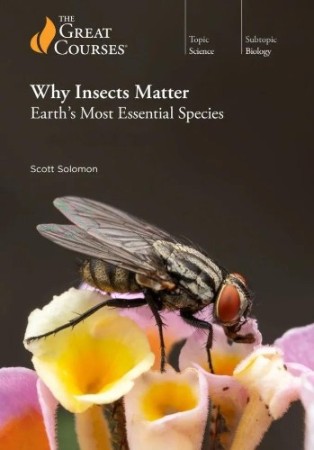
Lecturer: Scott Solomon, PhD Professor, Rice University | Course No. 10150
You are probably already aware of how important insects are to our own food web. About 35% of global crop production by volume relies on insect pollinators. But even more important, insects are responsible for recycling almost half of all dead organic matter on our planet; without insects, our world would be absolutely filled with dead plants, animals, and excrement.
Insect Superpowers
- Click beetles. Lacking the chemical defenses of some other beetles, this insect uses the element of surprise to get away. By arching its body in a specific way, a hinge-like structure makes a clicking noise as it launches the beetle a foot into the air-25 times its body length.
- Dracula ants. This ant has developed the fastest animal movement ever recorded-jaws that snap together at a speed of 200 miles per hour in just over 1 millionth of a second.
- Tiger beetles. Imagine running so fast that your brain can’t keep up processing the visual information coming your way. Tiger beetles can run 125 body lengths per second! They often have to slow down in order to see what’s in front of them-to give their brain time to catch up.
Avoiding the Ravages of War
Few insects are pacifists. And yet, like any animal, it is best to avoid the consequences of violent conflict, if possible-whether the conflict is within a group or between competing groups. While many insects do fight to the death, in this course, you’ll learn about several species that have evolved fascinating strategies to solve conflict without loss of life. These include:
- Desert honeypot ants. When workers from rival colonies encounter one another, they line up and extend their legs, making them look as if they are walking on stilts. Based on the number of workers each side recruits, the ants figure out which colony would win if they were to fight. The larger team wins; it’s as simple as that.
- Stalk-eyed flies. These flies have two long stalks that protrude out from the sides of the head, each of which supports an eye at the end. The longer a male’s eyestalk, the better his chances of mating and passing on his genes. Instead of physically fighting, the males gather together to compare their physiques two at a time. The male with the shorter eye stalks simply leaves.
- Honeybees. In the wild, honeybees have to find a new place to live each year as the colony grows. But without any real hierarchical structure, how can they avoid fighting over such a momentous decision? Although each colony does have a queen, her only job is to lay eggs-hour after hour, day after day. She does not function as a group leader. To meet their goal, scouts visit possible new home sites and evaluate them using the criteria honeybees care most about-entrance size, location, and volume. These bees return and “tell” their hive-mates about the potential new location via their waggle dance. Eventually, the site that is best suited will end up having more bees “waggling” in its favor than other sites. A completely democratic process in which each waggle counts.
Insects Did It First
One of the most significant milestones in human history was the development of agriculture about 10,000 years ago. But as it turns out, agriculture isn’t unique to humans. Insects have been using both agriculture and ranching for tens of millions of years. In this course, you will learn about:
- Agriculture. Leafcutter ants are famous for carrying leaves across the forest floor, but they can’t digest them on their own. Instead, they feed the leaves to the fungus they tend in their garden, and then eat the fungus, which they can digest.
- Pest Control. Some ants fight fungus-garden parasites with antibiotics. Bacteria that grow on the ant’s exoskeleton produce antibiotics that help keep parasites at bay.
Insects have certainly evolved some amazing physical and social abilities. Could we learn to develop flying machines as agile as the common housefly? Could we learn from the recycling, farming, and pest control practices of ants? Could we learn to build structures using the engineering intelligence of termites? In this course, you will join the scientists who are trying to do just that, and you might never look at the natural world in quite the same way.

DDownload
https://www.keeplinks.org/p27/699dc34c432d8
RapidGator
https://www.keeplinks.org/p27/699dc67eab00d
NitroFlare
https://www.keeplinks.org/p27/699dc99c9e781
TakeFile
https://www.keeplinks.org/p27/699dd0883e606